The number of seeds in a packet is a decision, not a default. When you order custom printed seed packets, the printer will ask two questions that catch most first-time buyers off guard: what species do you want inside, and at what fill weight? Those two answers determine whether your recipients get a pinch of dust or a garden bed’s worth of flowers, and they move your per-unit cost more than most people expect. This guide walks through how seed counts actually work, what standard fills deliver, and how to write a fill spec a supplier can quote accurately.
Seed count is set by species, not by packet size
The packet itself is nearly irrelevant to seed count. The standard custom packet in the US trade runs about 3.25 by 4.5 inches, and at typical fills the seed occupies a small fraction of the internal volume. What matters is the species, because seed size varies enormously. Published seeds-per-gram references put poppy at roughly 4,500 seeds per gram, lettuce and carrot around 800 to 1,000, tomato at 300 to 400, marigold at 250 to 300, cosmos and zinnia in the 120 to 150 range, and large-seeded species like sunflower down near 15 to 20 seeds per gram. That is a spread of more than two hundred to one between the smallest and largest common packet species.
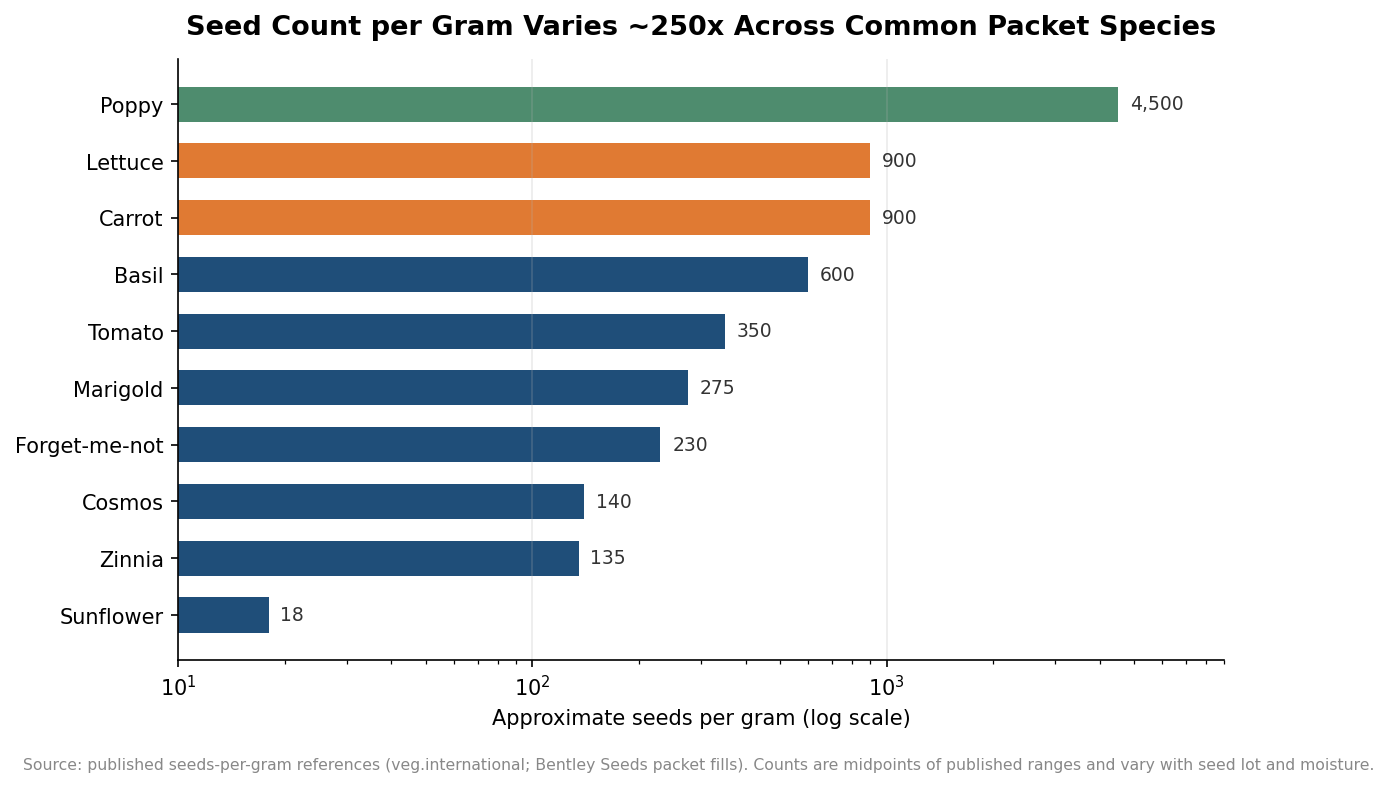
The practical consequence: a half-gram fill means wildly different things depending on what is in it. Half a gram of poppy is over two thousand seeds. Half a gram of sunflower is eight or nine seeds. Neither is wrong, but you should know which one you are buying before you approve the order.
What standard fills actually contain
Suppliers who publish their fills give a useful baseline. One established US personalized-packet supplier lists its wildflower mix at about 400 milligrams per packet, which works out to roughly 210 to 220 seeds. Its poppy packets carry about 100 milligrams, around 450 seeds, because the seed is so fine. Forget-me-not runs about 300 milligrams for 60 to 80 seeds, and sunflower packets step up to a full 2 grams to deliver just 20 to 30 seeds. Notice the pattern: fills are tuned so the recipient gets a satisfying planting, not a uniform weight. Fine-seeded species get lighter fills; big seeds need more grams to reach a usable count.
For a wedding or event favor, a 300 to 500 milligram wildflower fill is the de facto standard, and it is genuinely enough: a couple hundred mixed wildflower seeds will sow several square feet at the density seed houses recommend. Bulk coverage guides from wildflower suppliers put a quarter pound of mix at 250 to 500 square feet, which scales down to roughly 10 to 20 square feet per gram at the light end of the range. A favor packet is a real planting, not a gesture, as long as the mix is fresh and the fill is honest.
Matching fill to the job
Favors and promotional handouts sit comfortably at the light end. The recipient will scatter the packet in a pot or a corner bed, so 200 seeds of a showy annual mix is the right experience, and light fills keep the packet flat, which matters if you are mailing it inside an invitation or attaching it to a card. A flat 400-milligram packet typically rides along in a standard envelope without triggering additional postage for thickness, though you should always confirm nonmachinable rules with your mail shop.
Retail packets for garden centers need to match the expectations set by national seed racks, and those follow the same species logic: fine herbs and lettuces at a few hundred milligrams, beans and peas at several grams. If you are a grower packing your own varieties for sale, weigh out the count you want to deliver, then confirm the per-packet germination expectation for the species so the count survives real-world conditions.
Fundraisers usually want the lowest defensible fill, because margin per unit is the point. A fine-seeded species like poppy or a poppy-heavy mix delivers a big visual seed count at 100 to 200 milligrams, keeping cost of goods low while still giving the buyer a real result in the ground.
How fill and quantity move the price
Seed is a commodity priced by weight, so fill weight scales the seed portion of your cost almost linearly; doubling a wildflower fill from 400 to 800 milligrams roughly doubles the seed cost per unit, though seed is usually the smaller share of the total. Printing dominates at low quantities, and that is where the volume curve does its work. One published US price list for full-custom 3.25 by 4.5 inch packets runs $2.50 each at 100 packets, $1.35 at 250, $0.90 at 500, $0.80 at 1,000, and grinds down to $0.60 at 5,000, with a $55 setup fee on top. Other suppliers publish flat per-packet prices around $2.39 with 50-packet minimums for template-based personalization rather than full custom printing.
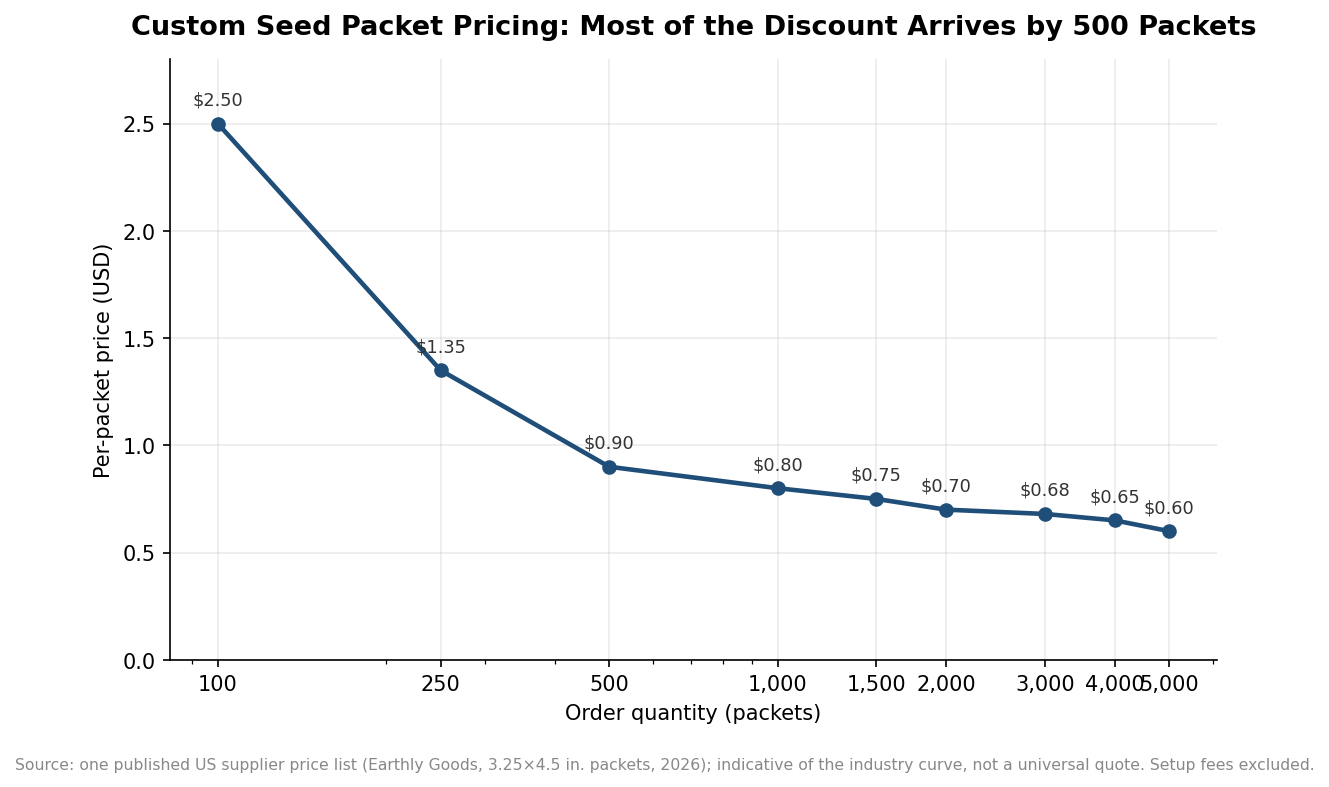
Read the curve before you pick a quantity. The steep savings happen early: moving from 100 to 500 packets cuts the unit price by nearly two-thirds on that published list, while moving from 1,000 to 5,000 saves another quarter. If your event needs 350 packets, pricing 500 is worth the ask, since the larger tier can cost barely more in total and leaves you spares for the inevitable extra requests. These figures are one supplier’s list and will vary with stock, printing method, and seed choice, but the shape of the curve is consistent across the industry.
Writing a fill spec your supplier can quote
A quotable spec has four parts. Name the species or mix precisely, since a named pollinator blend and a generic wildflower mix can differ several-fold in cost per gram. State the fill as a weight, in milligrams or grams, not as a seed count; suppliers fill by weight, and counts are always approximate because seed weight varies with lot, dryness, and humidity, sometimes by a wide margin. Give the quantity and ask for the next tier’s price at the same time. And ask two verification questions: the seed lot’s tested germination rate and packed-for year, both of which belong on the packet anyway under state seed labeling rules, and whether the fill is by weight or by volumetric scoop, since scoop fills drift more between packets.
If you take one number away from this piece, make it 400 milligrams: the wildflower favor fill that the established suppliers have converged on, delivering about two hundred seeds and a few square feet of bloom. Start there, adjust by species using the seeds-per-gram table, and let the quantity curve, not the fill, be where you push for savings.
Leave a Reply