A custom seed packet is a marketing surface, but the moment real seed goes inside and the packet is sold, it also becomes a regulated label. The rules are not obscure, and they are not optional, yet they are easy to miss when the focus is on artwork and finish. This is a plain-English explainer of what United States seed law expects to see on a packet, why those elements exist, and when the requirements actually apply to your order. It is general information rather than legal advice, and because the details vary from state to state, the safest final step is always to confirm with your state’s seed control official before you print a large run.
Two layers of rules: federal and state
Seed labeling sits under two overlapping systems. The Federal Seed Act, carried out through the regulations at 7 CFR Part 201, governs seed that moves across state lines, setting truth-in-labeling standards for interstate commerce. Each state then has its own seed law governing seed sold within that state, and while most states have aligned around a common model known as the Recommended Uniform State Seed Law, they are not identical, and a few requirements differ in the specifics. The practical result is that a packet sold nationally has to satisfy both the federal baseline and the rules of the states where it is sold. For most small retail packets the two layers ask for broadly the same core information, but the state layer is where extra items, such as a dated “sell by” line, most often appear. Treat the federal rules as the floor and the relevant state law as the version you actually have to meet.
The core elements every label carries
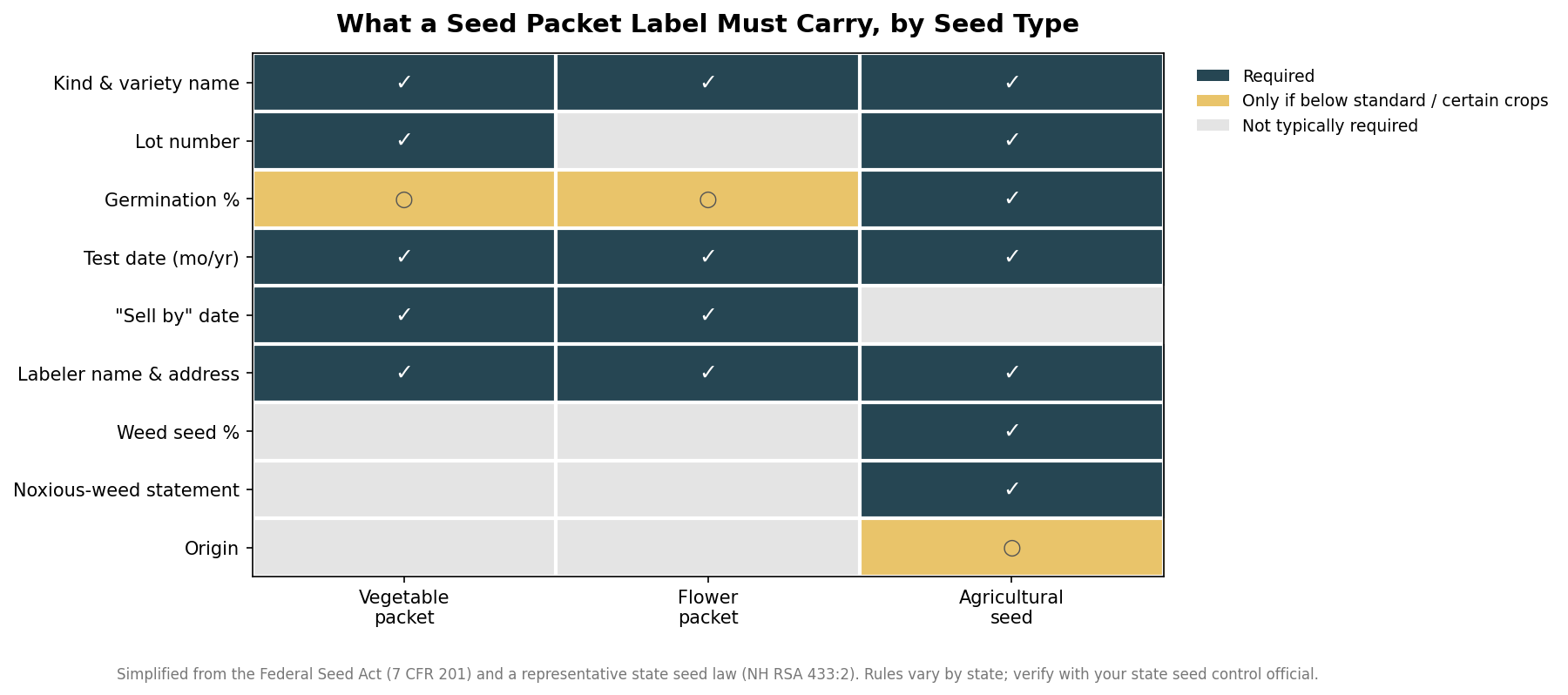
Strip away the branding and a compliant seed label comes down to a short list of facts a buyer needs to trust what they are planting. The name of the kind and variety must appear, so a packet says “Tomato, Brandywine” rather than just “tomato.” The name and address of the person or company responsible for labeling the seed, sometimes shown as an approved code for interstate shippers, has to be present so the seed is traceable to a source. A lot identification links the packet back to a specific tested batch, which is how a germination figure means anything at all; federal rules require lot identification on larger containers, and many state laws expect it on retail vegetable packets too. Germination information is where small packets get a break: under the federal rules, a vegetable packet of one pound or less that meets the minimum germination standard does not have to print the percentage, but if the seed falls below standard, the packet must say “Below Standard” prominently and show the actual figure. Agricultural seed is held to a fuller disclosure, including purity and germination percentages, because it is bought by the pound for production rather than by the packet for a garden.
The test date and the sell-by clock
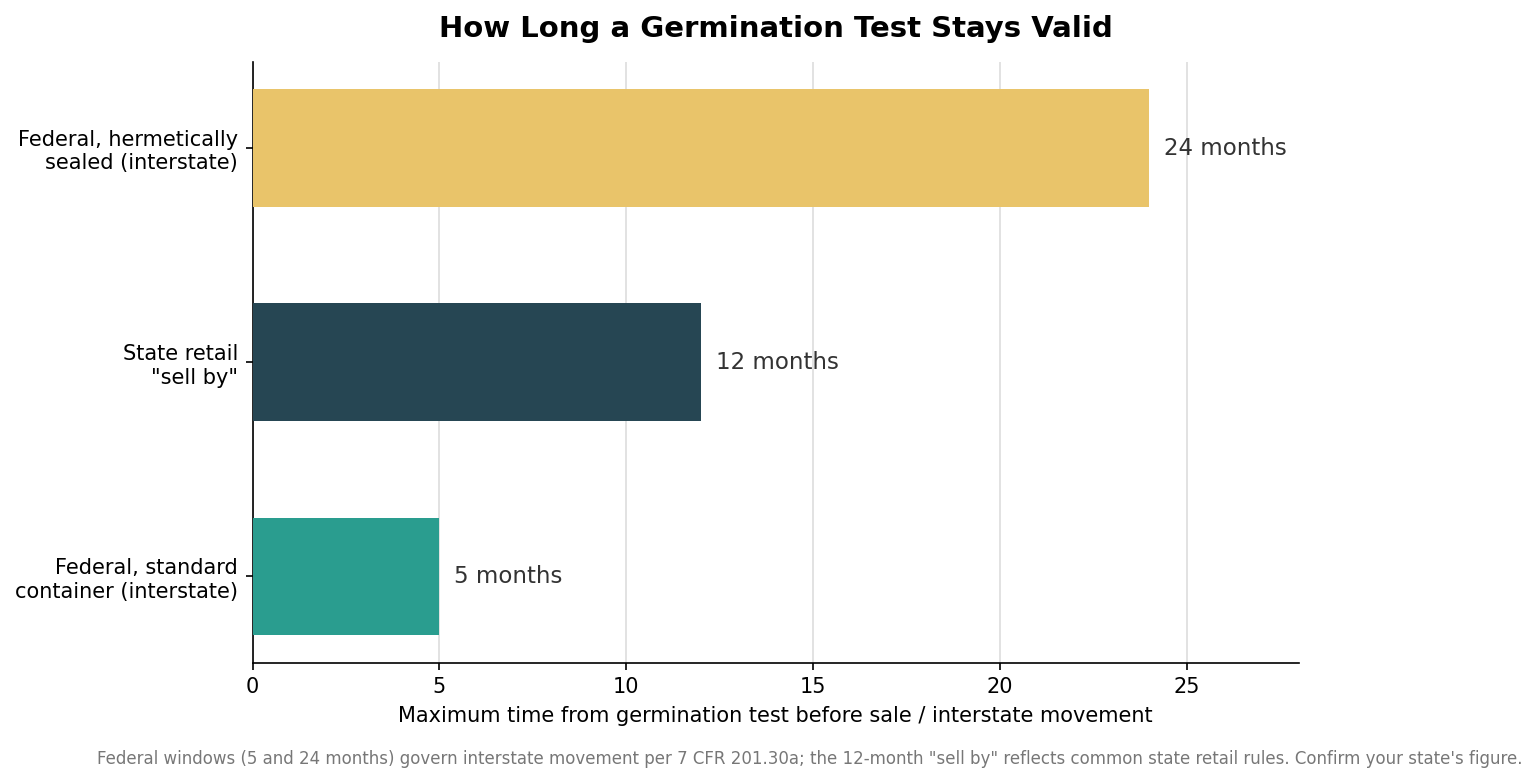
Germination is not a fixed property; it is the result of a test on a date, and seed loses viability as it ages, so the law ties the number to a clock. When a germination percentage is required, the label must show the month and year the test was completed, and that date starts a countdown. Under the federal regulations, no more than five calendar months may pass between the completion of the test and interstate movement for seed in ordinary containers, a window that extends to twenty-four months for seed in hermetically sealed containers that hold moisture out. Many state laws frame the same idea for retail packets as a printed “sell by” date, commonly set within twelve months of the test. The reason this matters for a custom order is timing: you cannot print a huge stock of packets against a test done long ago and expect to keep selling them, because the test date, not the print date, governs how long the seed may be sold. Plan the germination testing and the print run close together, and order quantities you can actually sell inside the window.
Where weed seed, noxious weeds, and origin come in
Some of the most consequential requirements apply mainly to agricultural seed rather than to garden vegetable and flower packets, and it is worth knowing the difference so you neither over-label nor under-label. Agricultural seed labels must disclose the percentage by weight of weed seed, name any restricted noxious weeds and how often they occur, and for certain crops state the origin, because a contaminated lot of field seed can spread a regulated weed across a region. Each state maintains its own list of prohibited and restricted noxious weeds, and those lists differ, which is another reason the state layer cannot be ignored. For a typical custom vegetable or flower packet these weed and origin lines usually do not apply, but the category of seed you are packaging determines which rules attach, so identify whether your product is legally a vegetable, flower, or agricultural seed before assuming which elements you need. When in doubt, the seed supplier who tested the lot can tell you which disclosures the seed itself triggers.
Does this apply to you?
The rules bite when seed is sold, so the honest first question is whether your packets are being sold or simply given away. Seed offered for sale at retail, at a garden center, through a fundraiser, or online, falls squarely within seed labeling law, and the packet needs the applicable elements above. Packets given away as promotional items or event favors sit in a grayer area, and enforcement priorities differ, but the moment money changes hands for the seed the packet is a regulated label, and even for giveaways it is good practice to identify the kind, variety, and a test date so recipients get a fair chance at germination. The most reliable move before a significant print run is to contact the seed control official in the state where the seed will be sold, describe your product, and confirm the exact list and wording your label must carry. It is a short conversation that turns an attractive packet into a compliant one, and it is far cheaper than reprinting a run that a regulator flags. Get the label right and the design does its job free of legal risk; get it wrong and the nicest artwork in the world will not save the order.
Leave a Reply