Category: Uncategorized

  • Choosing the Right Seeds for Promotional Seed Packets: A Selection Guide

    Choosing the Right Seeds for Promotional Seed Packets: A Selection Guide

    Most advice about custom seed packets stops at the packet: the paper, the print, the size, the price. But the packet is only the wrapper. What decides whether your giveaway ends up as a photo of blooming flowers on someone’s windowsill, or as a dead handful of stems and a quiet disappointment, is the seed you put inside it. Choosing that variety is a real decision with real trade-offs, and it deserves as much thought as the artwork on the front. This guide walks through how to pick the right seed for a promotional or event seed packet.

    Start With the Goal, Not the Flower

    Before you look at any variety, decide what the packet is actually for, because that changes everything downstream. A wedding or event favor wants a near-guaranteed sprout and a memorable bloom, so reliability beats novelty. A pollinator or sustainability campaign wants flowers that genuinely feed bees and butterflies, which points toward wildflower or native mixes. A brand or color-matched giveaway might need a specific flower color, like a single-variety sunflower or cosmos, to tie into your visual identity. And an edible or kitchen angle leans on herbs such as basil, cilantro, or chives. Naming the goal first turns an overwhelming catalog into a short list, and stops you from picking a beautiful flower that happens to be hard to grow or wrong for the audience.

    The Foolproof Shortlist for Giveaways

    If the priority is that the seed simply grows for a non-gardener who may plant it late, in poor soil, and then forget about it, a handful of varieties do most of the heavy lifting. Sunflowers, zinnias, marigolds, cosmos, and nasturtiums are the classic favor flowers because they germinate quickly, tolerate neglect, and reward the grower with obvious color in a single season. Reputable seed companies test their batches and commonly publish germination rates above 85 to 90 percent, and the easiest annuals sprout in roughly five to ten days, with some fast starters like coreopsis and yarrow showing green in as little as three. On the edible side, basil, cilantro, and chives are similarly forgiving and add a practical hook that flowers do not.

    The most useful rule for giveaways is that a single, clearly labeled species is almost always more foolproof than a mixed blend. With one variety you can print exact sowing depth, spacing, and days-to-bloom on the packet, the recipient sees uniform results, and there is no confusion when half a mix behaves one way and half behaves another. Save the mixes for campaigns where variety is the point.
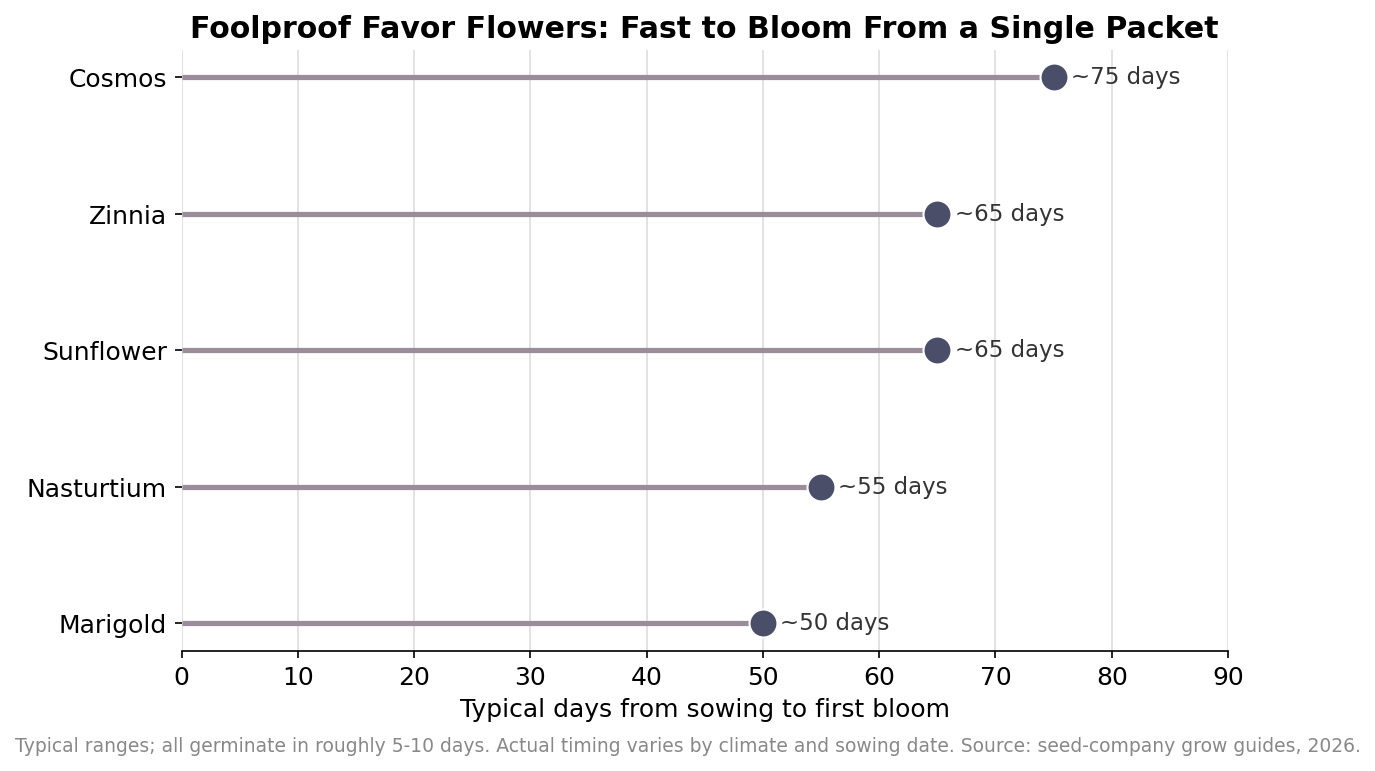
    Dot plot of typical days from sowing to first bloom for foolproof favor flowers marigold, nasturtium, sunflower, zinnia and cosmos
    Classic favor annuals bloom fast from a single packet, most within about 50 to 75 days of sowing.

    Wildflower and Pollinator Mixes: Powerful but Trickier

    Wildflower mixes are the natural choice for pollinator and sustainability messaging, but they behave very differently from a single annual, and buyers are often surprised. Most mixes contain a blend of annuals and perennials. The annuals do the visible work in the first season, typically blooming within about sixty to ninety days of germination, while the perennials usually need a cold period before they will even sprout and will not put on a real show until the second or third year. That means a spring-distributed wildflower favor can look sparse compared to a fast annual, and one or two vigorous species often come to dominate the planting after the second year. If you choose a mix, set expectations on the packet so recipients understand they are planting a multi-year project, not an instant meadow.
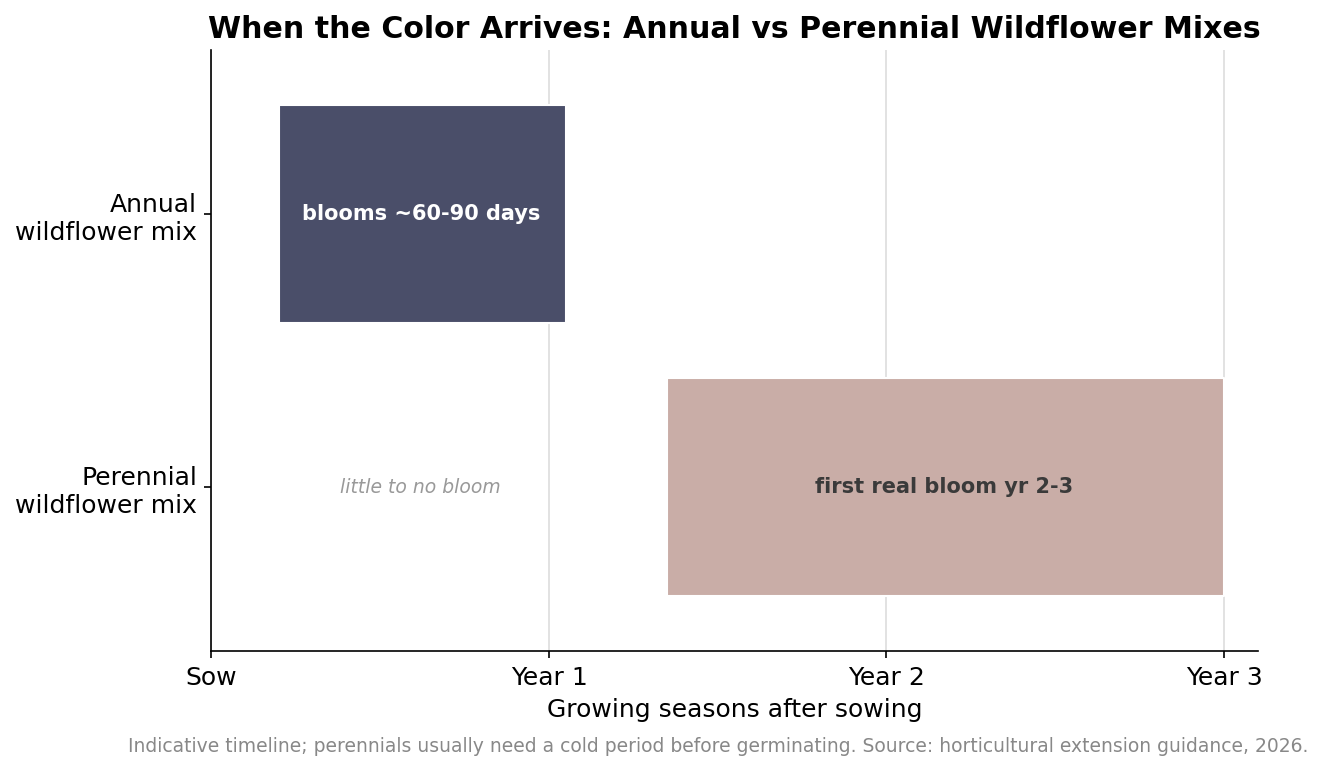
    Timeline chart comparing when annual and perennial wildflower mixes come into bloom across the first three growing seasons
    Annual mixes deliver color in the first season; perennials in a mix usually wait until year two or three.

    Match the Seed to the Region, and Don’t Ship a Problem

    A seed that is a cheerful wildflower in one state can be an aggressive or even legally restricted weed in another, which is why the region matters as much as the flower. Roughly half of the plants in a typical wildflower mix are non-native, and extension horticulturists specifically warn about unmarked, generic mixes handed out as wedding favors because no one can vouch for what is inside. The safer path is to choose seed formulated for the recipients’ broad region and USDA hardiness zone, to favor native or clearly labeled mixes over anonymous blends, and to avoid anything that could naturalize where it is not wanted. When a campaign will reach many states at once, a well-known, non-invasive single annual is often a smarter choice than a regional wildflower mix you cannot tailor, and your local Extension Master Gardener program can sanity-check a mix before you commit to thousands of packets.

    Quantity, Timing, and the Instructions on the Packet

    Finally, match the amount of seed and the timing to how the packet will be used. A favor packet usually holds only a small fill, often well under a couple of grams, which is plenty for a windowsill pot or a few square feet when broadcast, so you are paying for reliability and presentation rather than bulk. Timing matters too: seed handed out in the right planting season for the recipients’ climate is far more likely to be sown promptly and succeed, so align a giveaway with spring where you can. Above all, print real growing instructions on the packet. Sowing depth, spacing, light, and days to bloom turn a pretty envelope into something a first-time grower can actually follow, and packets printed with complete instructions measurably reduce the learning curve for beginners.

    Put together, choosing seed for a custom packet is a short sequence: define the goal, favor a reliable and clearly labeled variety, respect the recipients’ region, and print instructions that set the grower up to win. Ask your supplier for the germination test data and origin of the seed, and where color accuracy or growability matters, plant a test packet yourself before you order the full run. The numbers here are typical ranges rather than guarantees, so confirm the specifics for the exact seed lot you buy.
  • Will the Seeds Still Grow? Shelf Life, Storage, and What Your Packet Has to Handle

    Will the Seeds Still Grow? Shelf Life, Storage, and What Your Packet Has to Handle

    A custom seed packet is judged twice: once when someone admires the printing, and again months later when they push the seeds into soil and wait. The second test is the one that matters, and it is decided less by the packet’s looks than by which seeds went inside, how old they were, and where the box sat between your order and the recipient’s garden. If you are printing favors for a spring wedding, promotional packets for a trade show, or a fundraising run that will sell down slowly, it pays to understand what actually keeps seeds alive so the germination photo you are picturing is the one people get.

    Viability is a species trait first

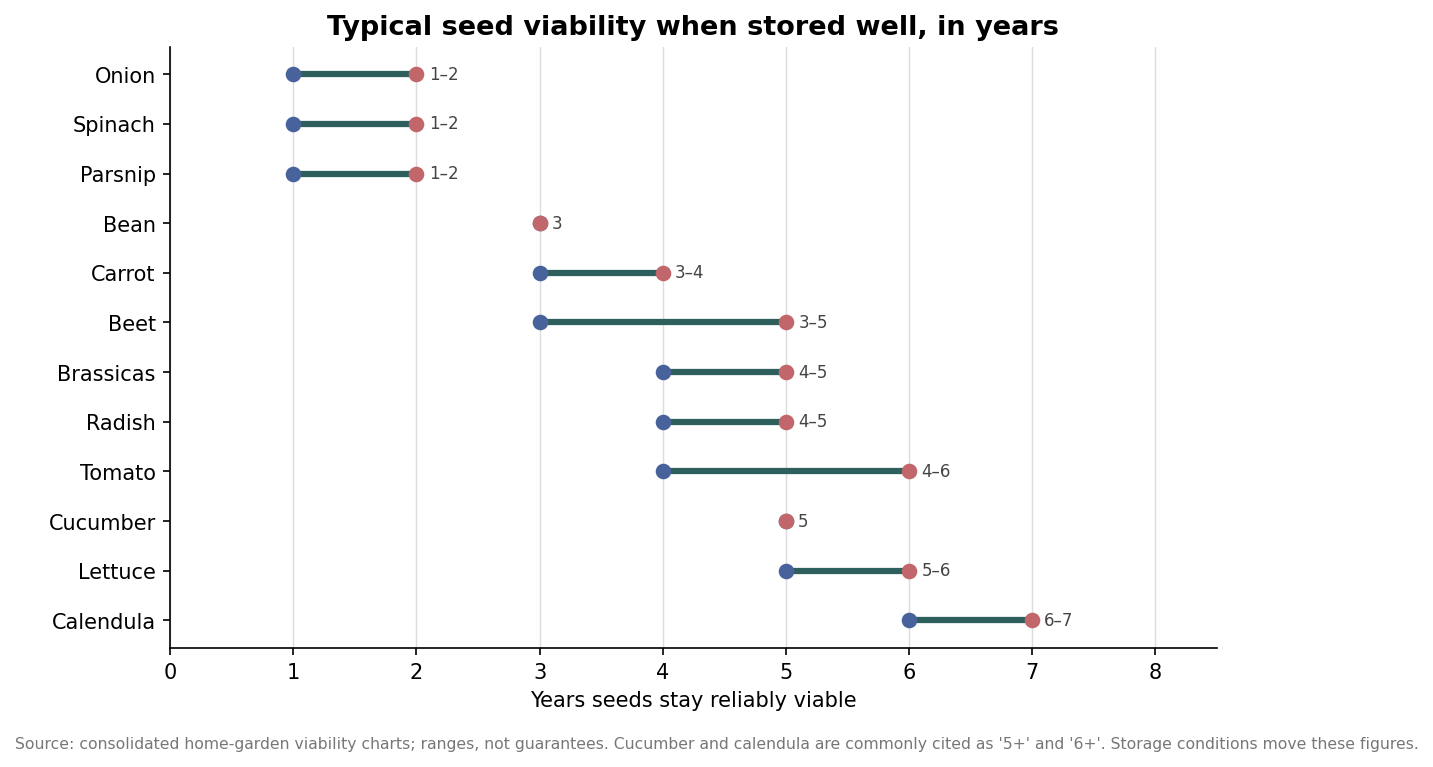
    Before storage or packaging enters the picture, the species sets the ceiling. Seeds are living tissue, and different plants simply hold their spark for different lengths of time. At the short end, onion, leek, spinach, and parsnip seed is notoriously fleeting, often reliable for only one to two years even under good conditions. In the middle sit carrots at roughly three to four years and beans around three. At the durable end, tomato, lettuce, cucumber, brassicas, and radish commonly stay viable for four to six years, and a few flowers such as calendula are cited well beyond that. These are ranges, not guarantees; they describe seed kept cool and dry, and they slide downward as conditions worsen.

    Range dot plot of typical seed viability in years by species, from onion at 1-2 years to calendula at 6 or more
    Seed viability is a species trait first: alliums fade in a year or two, tomatoes and lettuce hold for years.

    The practical takeaway for a custom order is to match the species to how long the packet will realistically sit before planting. A wildflower or tomato mix tolerates a slow sell-through; an allium or spinach packet distributed a year after you bought the seed is already fighting its own biology. If a campaign will run for many months, lean toward the long-lived species, or plan to refresh the seed stock rather than the print run.

    The rule that governs the rest: temperature plus humidity

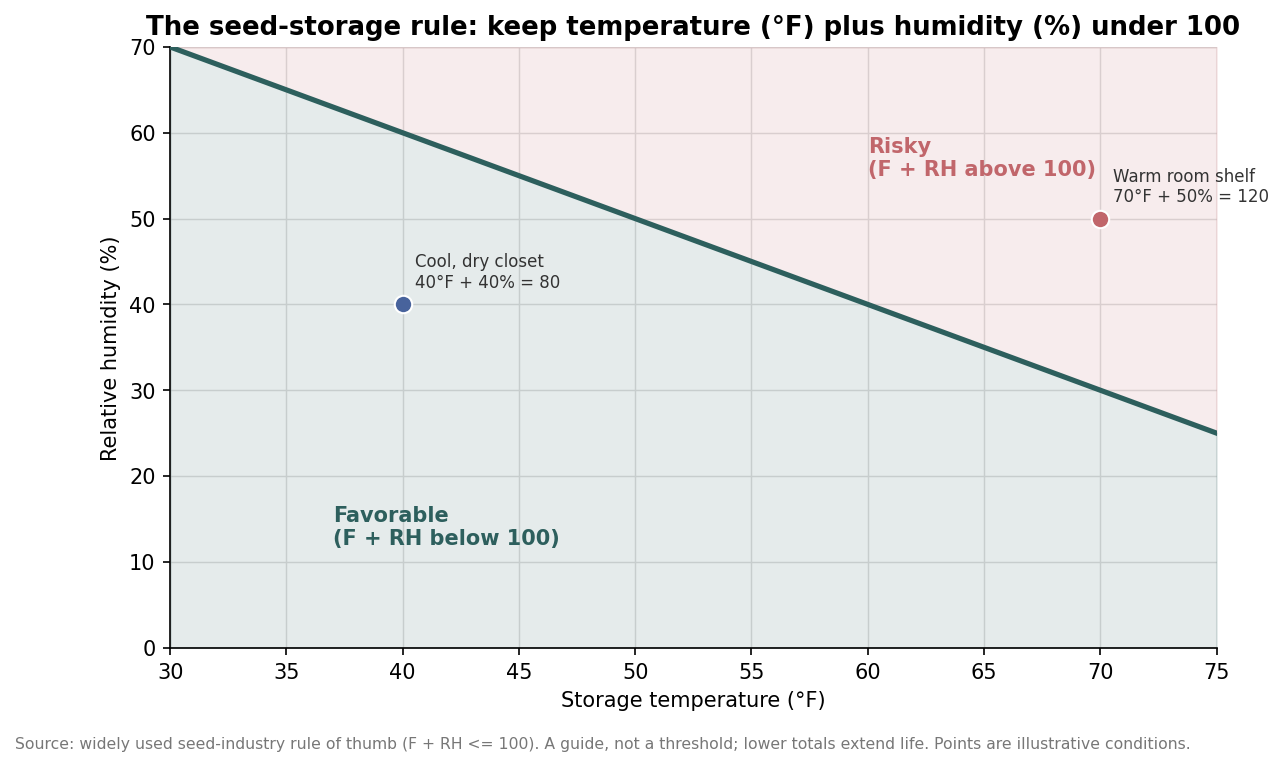
    Seed people carry one rule of thumb that captures most of what goes wrong in storage: the temperature in degrees Fahrenheit plus the relative humidity as a percentage should stay under 100, and the further below that total you get, the longer seeds last. A cool, dry closet at about 40°F and 40% humidity totals 80 and is comfortably favorable. A warm room shelf at 70°F and 50% humidity totals 120 and quietly ages seed faster than most people realize. Heat speeds the seed’s respiration, and moisture invites the mold and insects that finish the job.

    Line and shaded area chart of the seed storage rule where temperature in Fahrenheit plus relative humidity should stay under 100
    Keep storage temperature (°F) plus humidity (%) under 100; lower totals extend seed life.

    Commercial seed is dried to under about 10% moisture after harvest precisely so it ships in a stable state, and short-term storage guidance typically points at 35 to 50°F with 30 to 40% relative humidity. You cannot control the recipient’s shelf, but you can control the months the packets spend in your possession. A garage that bakes in summer or a basement that sweats in humidity is exactly the wrong holding spot; a climate-steady interior closet is the right one. Pelleted or coated seed is a special case worth flagging, since the coating shortens shelf life and is generally best used within a single year.

    What the packet itself can and cannot do

    Packaging is the last line of defense, and it is important to be honest about its limits. A standard paper seed packet breathes, which is perfectly fine for seed that will be handed out and planted within a season, and it is the traditional look most buyers want for weddings and events. What paper does not do is create a moisture barrier, so it will not protect seed through a humid summer in storage. When packets need to hold for many months, a foil-lined or poly-laminate envelope seals out moisture far better, and a tiny silica desiccant tucked into bulk storage keeps the surrounding air dry. The choice is a genuine trade-off between the paper look and the barrier performance, and the right answer depends entirely on your timeline.

    Print finish plays a quiet supporting role here too. A coated or laminated exterior resists the handling and humidity of a market table better than an uncoated kraft face, though neither finish changes what happens to seed sealed inside a breathable paper pocket. If longevity is the priority, solve it with the inner barrier and storage conditions rather than expecting the outer print to do that work.

    Ordering ahead without gambling on germination

    The tension in most custom seed-packet orders is that printing rewards planning ahead while seed viability punishes it. You resolve it by separating the two clocks. Lock in artwork, proofs, and quantities early, because those never expire, and time the actual seed fill as close to distribution as the production schedule allows. If you must buy seed well in advance, buy long-lived species, store them cool and dry per the rule above, and note the seed’s own packed-on or test date so you know how much runway is left. For anything mission-critical, ask your supplier for the germination rate the seed lot was tested at; reputable seed carries a tested percentage, and a lot in the 85 to 95% range gives you real margin.

    Testing a batch before it goes out

    You do not have to trust the numbers blindly. A simple rag-doll germination test settles it: count out ten seeds, roll them in a damp paper towel, keep it warm, and check after the species’ expected germination window of roughly a week to two. Seven or more sprouts out of ten points to a healthy lot; three or four is a warning to refresh the stock before you commit it to hundreds of packets someone is counting on. Running that test on a pinch of seed costs almost nothing and turns viability from a hope into a measured fact, which is exactly the confidence you want before a run goes out under your name.

  • How Many Seeds Go in a Custom Seed Packet? Fill Weights by Species

    How Many Seeds Go in a Custom Seed Packet? Fill Weights by Species

    The number of seeds in a packet is a decision, not a default. When you order custom printed seed packets, the printer will ask two questions that catch most first-time buyers off guard: what species do you want inside, and at what fill weight? Those two answers determine whether your recipients get a pinch of dust or a garden bed’s worth of flowers, and they move your per-unit cost more than most people expect. This guide walks through how seed counts actually work, what standard fills deliver, and how to write a fill spec a supplier can quote accurately.

    Seed count is set by species, not by packet size

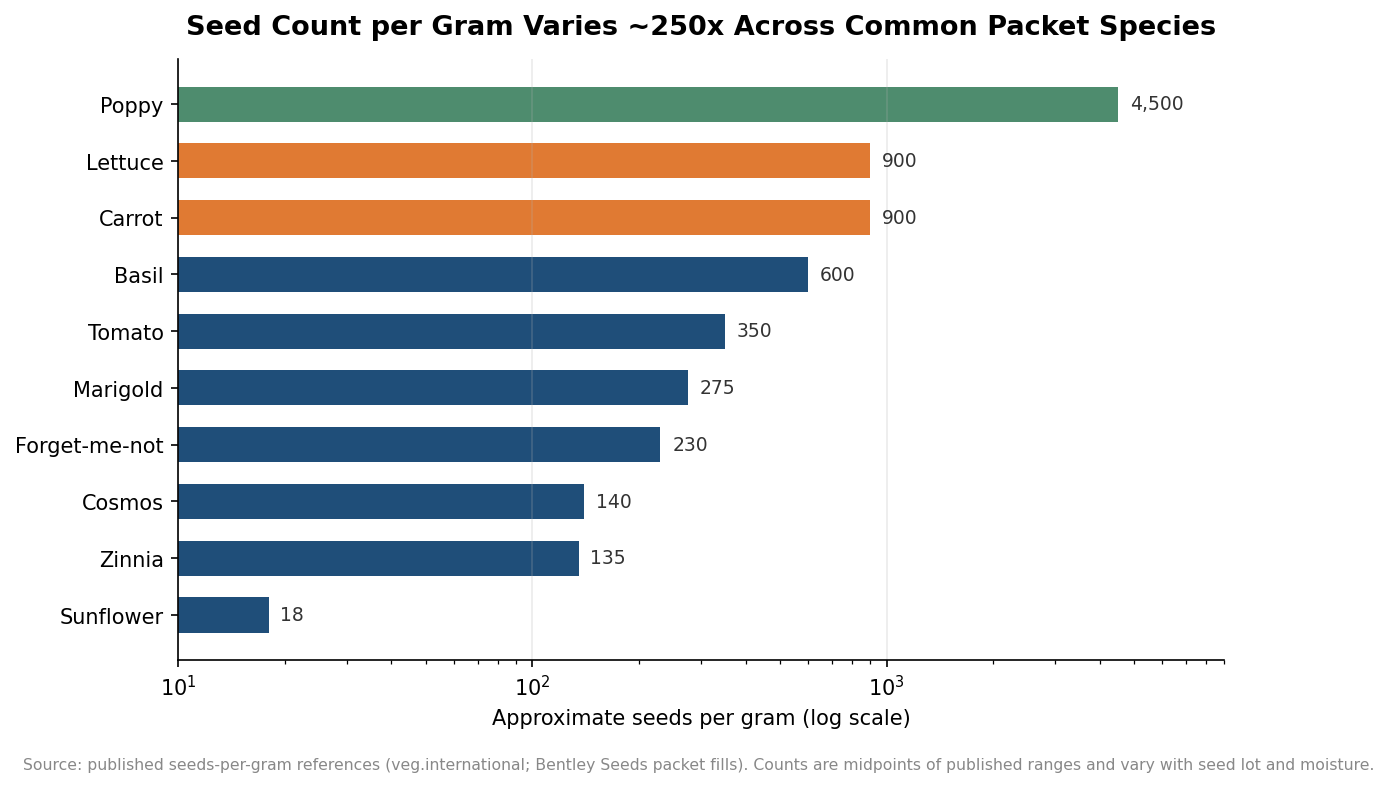
    The packet itself is nearly irrelevant to seed count. The standard custom packet in the US trade runs about 3.25 by 4.5 inches, and at typical fills the seed occupies a small fraction of the internal volume. What matters is the species, because seed size varies enormously. Published seeds-per-gram references put poppy at roughly 4,500 seeds per gram, lettuce and carrot around 800 to 1,000, tomato at 300 to 400, marigold at 250 to 300, cosmos and zinnia in the 120 to 150 range, and large-seeded species like sunflower down near 15 to 20 seeds per gram. That is a spread of more than two hundred to one between the smallest and largest common packet species.

    Horizontal bar chart showing approximate seeds per gram for ten common packet species, ranging from about 18 for sunflower to about 4,500 for poppy
    Seed size drives everything: a gram of poppy holds roughly 250 times as many seeds as a gram of sunflower.

    The practical consequence: a half-gram fill means wildly different things depending on what is in it. Half a gram of poppy is over two thousand seeds. Half a gram of sunflower is eight or nine seeds. Neither is wrong, but you should know which one you are buying before you approve the order.

    What standard fills actually contain

    Suppliers who publish their fills give a useful baseline. One established US personalized-packet supplier lists its wildflower mix at about 400 milligrams per packet, which works out to roughly 210 to 220 seeds. Its poppy packets carry about 100 milligrams, around 450 seeds, because the seed is so fine. Forget-me-not runs about 300 milligrams for 60 to 80 seeds, and sunflower packets step up to a full 2 grams to deliver just 20 to 30 seeds. Notice the pattern: fills are tuned so the recipient gets a satisfying planting, not a uniform weight. Fine-seeded species get lighter fills; big seeds need more grams to reach a usable count.

    For a wedding or event favor, a 300 to 500 milligram wildflower fill is the de facto standard, and it is genuinely enough: a couple hundred mixed wildflower seeds will sow several square feet at the density seed houses recommend. Bulk coverage guides from wildflower suppliers put a quarter pound of mix at 250 to 500 square feet, which scales down to roughly 10 to 20 square feet per gram at the light end of the range. A favor packet is a real planting, not a gesture, as long as the mix is fresh and the fill is honest.

    Matching fill to the job

    Favors and promotional handouts sit comfortably at the light end. The recipient will scatter the packet in a pot or a corner bed, so 200 seeds of a showy annual mix is the right experience, and light fills keep the packet flat, which matters if you are mailing it inside an invitation or attaching it to a card. A flat 400-milligram packet typically rides along in a standard envelope without triggering additional postage for thickness, though you should always confirm nonmachinable rules with your mail shop.

    Retail packets for garden centers need to match the expectations set by national seed racks, and those follow the same species logic: fine herbs and lettuces at a few hundred milligrams, beans and peas at several grams. If you are a grower packing your own varieties for sale, weigh out the count you want to deliver, then confirm the per-packet germination expectation for the species so the count survives real-world conditions.

    Fundraisers usually want the lowest defensible fill, because margin per unit is the point. A fine-seeded species like poppy or a poppy-heavy mix delivers a big visual seed count at 100 to 200 milligrams, keeping cost of goods low while still giving the buyer a real result in the ground.

    How fill and quantity move the price

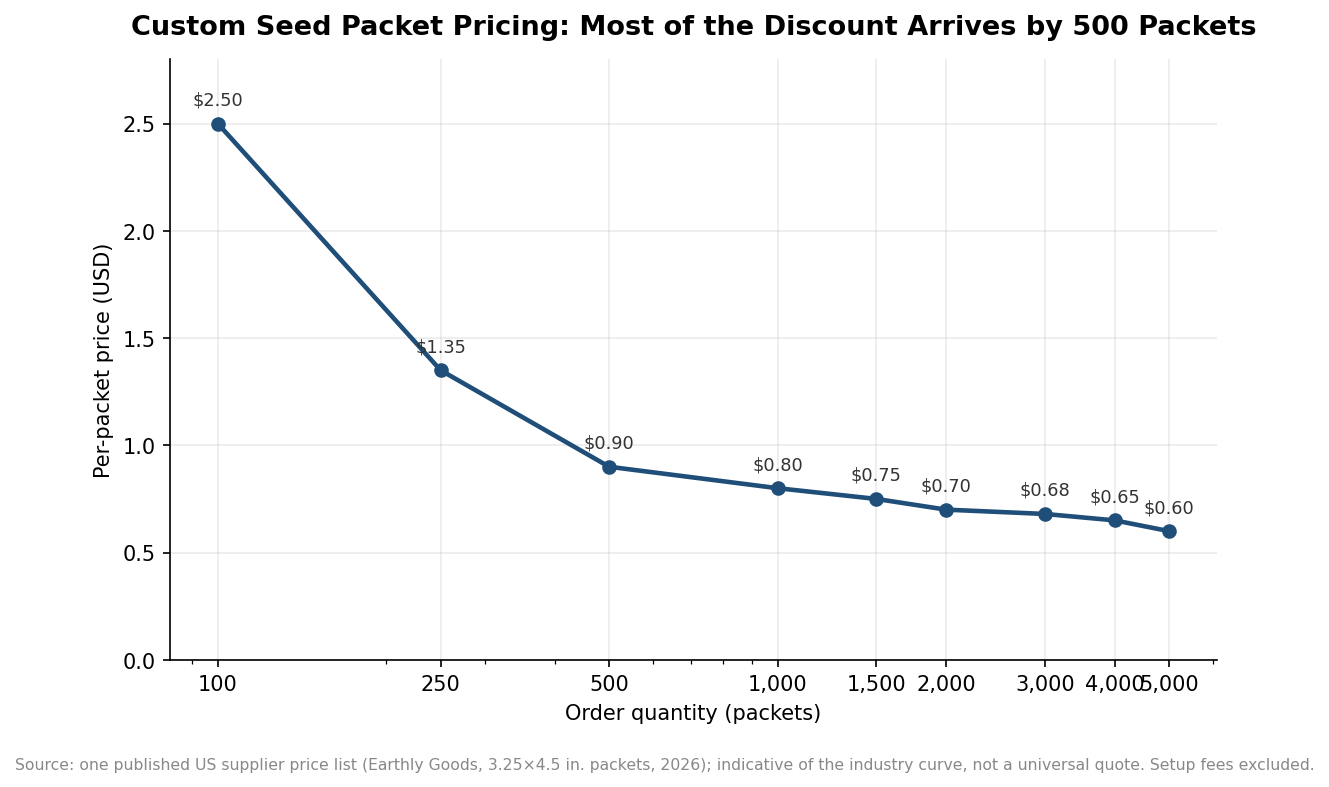
    Seed is a commodity priced by weight, so fill weight scales the seed portion of your cost almost linearly; doubling a wildflower fill from 400 to 800 milligrams roughly doubles the seed cost per unit, though seed is usually the smaller share of the total. Printing dominates at low quantities, and that is where the volume curve does its work. One published US price list for full-custom 3.25 by 4.5 inch packets runs $2.50 each at 100 packets, $1.35 at 250, $0.90 at 500, $0.80 at 1,000, and grinds down to $0.60 at 5,000, with a $55 setup fee on top. Other suppliers publish flat per-packet prices around $2.39 with 50-packet minimums for template-based personalization rather than full custom printing.

    Line chart of per-packet price versus order quantity for custom seed packets, falling from $2.50 at 100 packets to $0.60 at 5,000
    One published supplier price list for full-custom packets: unit price falls steeply up to about 500 packets, then flattens.

    Read the curve before you pick a quantity. The steep savings happen early: moving from 100 to 500 packets cuts the unit price by nearly two-thirds on that published list, while moving from 1,000 to 5,000 saves another quarter. If your event needs 350 packets, pricing 500 is worth the ask, since the larger tier can cost barely more in total and leaves you spares for the inevitable extra requests. These figures are one supplier’s list and will vary with stock, printing method, and seed choice, but the shape of the curve is consistent across the industry.

    Writing a fill spec your supplier can quote

    A quotable spec has four parts. Name the species or mix precisely, since a named pollinator blend and a generic wildflower mix can differ several-fold in cost per gram. State the fill as a weight, in milligrams or grams, not as a seed count; suppliers fill by weight, and counts are always approximate because seed weight varies with lot, dryness, and humidity, sometimes by a wide margin. Give the quantity and ask for the next tier’s price at the same time. And ask two verification questions: the seed lot’s tested germination rate and packed-for year, both of which belong on the packet anyway under state seed labeling rules, and whether the fill is by weight or by volumetric scoop, since scoop fills drift more between packets.

    If you take one number away from this piece, make it 400 milligrams: the wildflower favor fill that the established suppliers have converged on, delivering about two hundred seeds and a few square feet of bloom. Start there, adjust by species using the seeds-per-gram table, and let the quantity curve, not the fill, be where you push for savings.

  • What the Law Requires on a Seed Packet Label

    What the Law Requires on a Seed Packet Label

    A custom seed packet is a marketing surface, but the moment real seed goes inside and the packet is sold, it also becomes a regulated label. The rules are not obscure, and they are not optional, yet they are easy to miss when the focus is on artwork and finish. This is a plain-English explainer of what United States seed law expects to see on a packet, why those elements exist, and when the requirements actually apply to your order. It is general information rather than legal advice, and because the details vary from state to state, the safest final step is always to confirm with your state’s seed control official before you print a large run.

    Two layers of rules: federal and state

    Seed labeling sits under two overlapping systems. The Federal Seed Act, carried out through the regulations at 7 CFR Part 201, governs seed that moves across state lines, setting truth-in-labeling standards for interstate commerce. Each state then has its own seed law governing seed sold within that state, and while most states have aligned around a common model known as the Recommended Uniform State Seed Law, they are not identical, and a few requirements differ in the specifics. The practical result is that a packet sold nationally has to satisfy both the federal baseline and the rules of the states where it is sold. For most small retail packets the two layers ask for broadly the same core information, but the state layer is where extra items, such as a dated “sell by” line, most often appear. Treat the federal rules as the floor and the relevant state law as the version you actually have to meet.

    The core elements every label carries

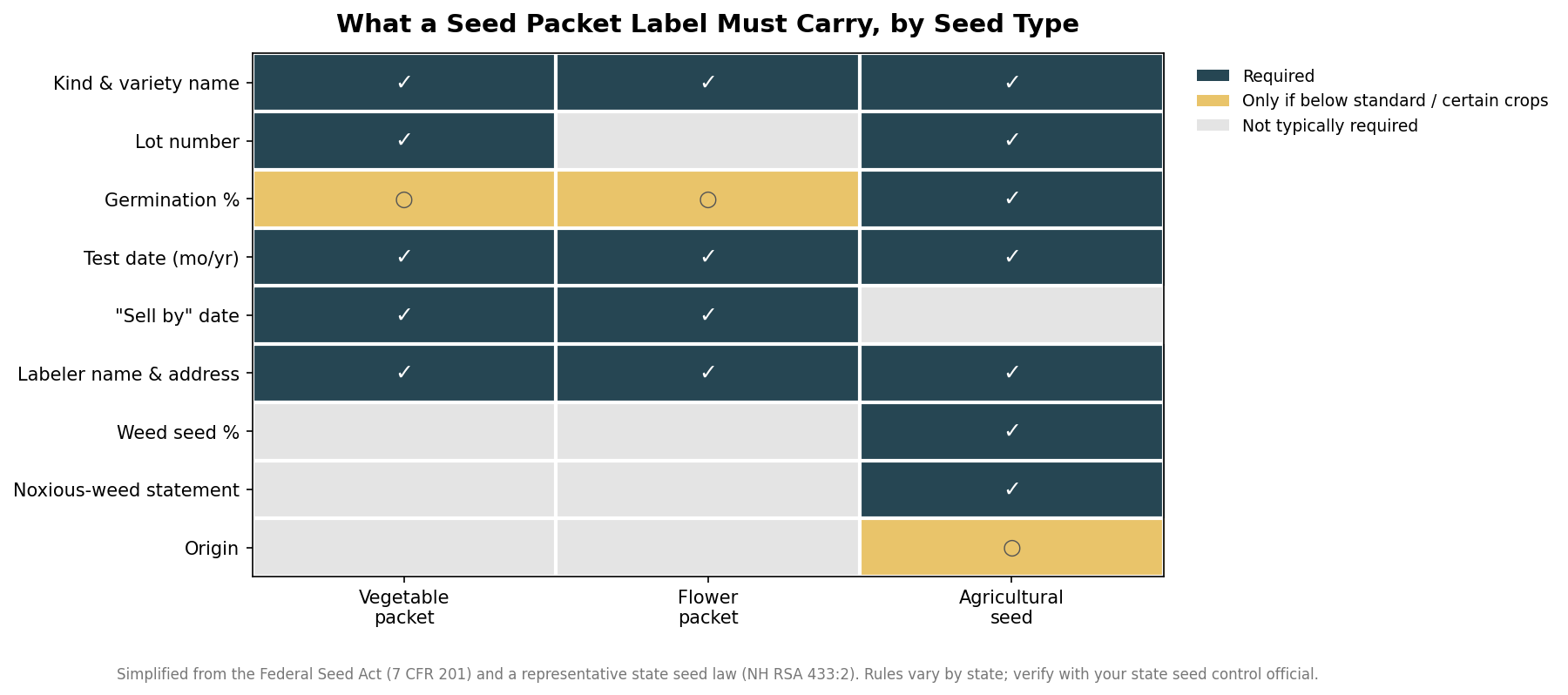
    Strip away the branding and a compliant seed label comes down to a short list of facts a buyer needs to trust what they are planting. The name of the kind and variety must appear, so a packet says “Tomato, Brandywine” rather than just “tomato.” The name and address of the person or company responsible for labeling the seed, sometimes shown as an approved code for interstate shippers, has to be present so the seed is traceable to a source. A lot identification links the packet back to a specific tested batch, which is how a germination figure means anything at all; federal rules require lot identification on larger containers, and many state laws expect it on retail vegetable packets too. Germination information is where small packets get a break: under the federal rules, a vegetable packet of one pound or less that meets the minimum germination standard does not have to print the percentage, but if the seed falls below standard, the packet must say “Below Standard” prominently and show the actual figure. Agricultural seed is held to a fuller disclosure, including purity and germination percentages, because it is bought by the pound for production rather than by the packet for a garden.

    Grid showing which seed label elements are required for vegetable packets, flower packets, and agricultural seed under federal and state seed law
    Which label elements are required, conditional, or not typically required, by seed type.

    The test date and the sell-by clock

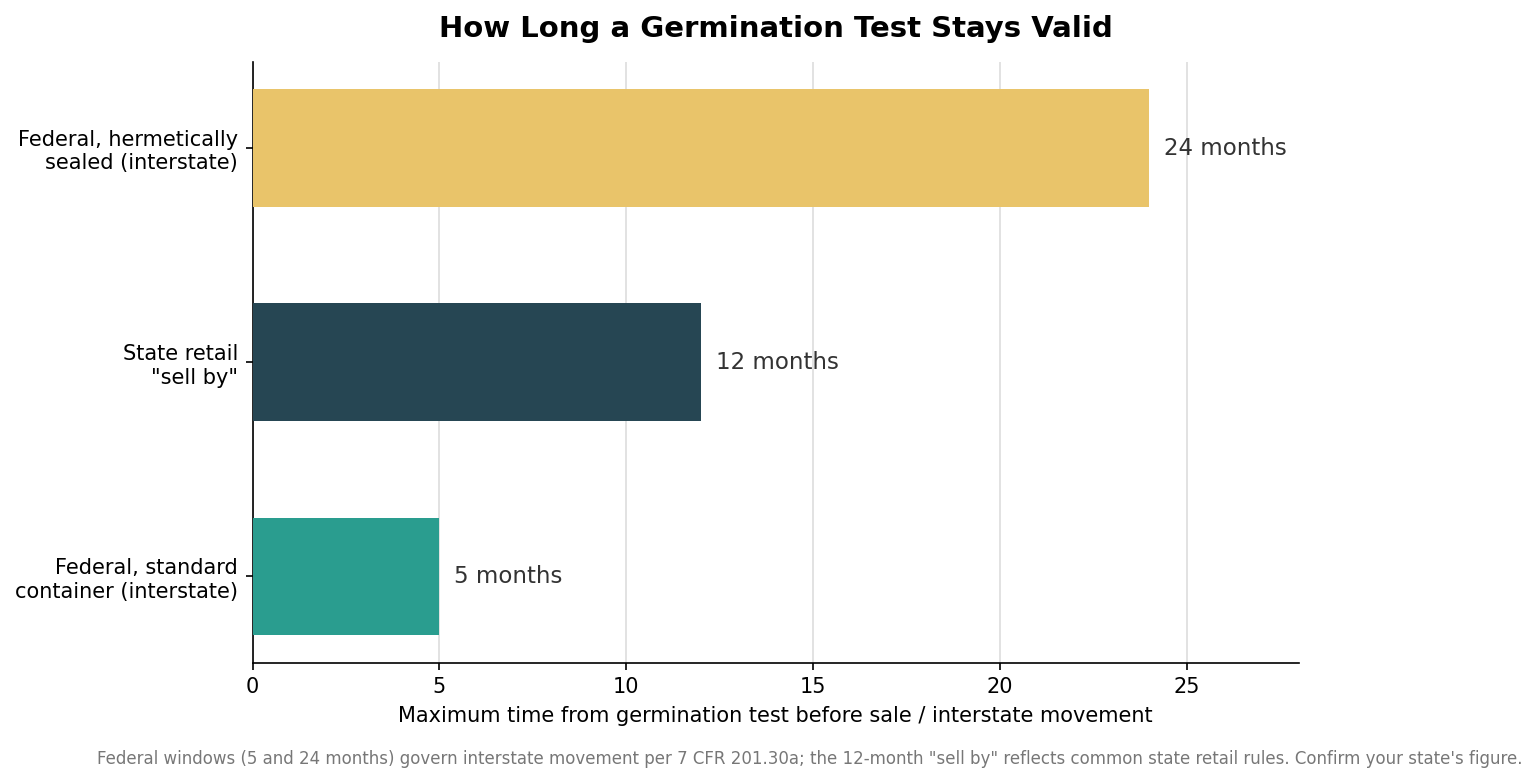
    Germination is not a fixed property; it is the result of a test on a date, and seed loses viability as it ages, so the law ties the number to a clock. When a germination percentage is required, the label must show the month and year the test was completed, and that date starts a countdown. Under the federal regulations, no more than five calendar months may pass between the completion of the test and interstate movement for seed in ordinary containers, a window that extends to twenty-four months for seed in hermetically sealed containers that hold moisture out. Many state laws frame the same idea for retail packets as a printed “sell by” date, commonly set within twelve months of the test. The reason this matters for a custom order is timing: you cannot print a huge stock of packets against a test done long ago and expect to keep selling them, because the test date, not the print date, governs how long the seed may be sold. Plan the germination testing and the print run close together, and order quantities you can actually sell inside the window.

    Horizontal bar chart of how long a germination test stays valid: 5 months federal standard container, 12 months state sell-by, 24 months hermetically sealed
    The germination test date starts a clock; federal windows govern interstate movement and states set a retail sell-by.

    Where weed seed, noxious weeds, and origin come in

    Some of the most consequential requirements apply mainly to agricultural seed rather than to garden vegetable and flower packets, and it is worth knowing the difference so you neither over-label nor under-label. Agricultural seed labels must disclose the percentage by weight of weed seed, name any restricted noxious weeds and how often they occur, and for certain crops state the origin, because a contaminated lot of field seed can spread a regulated weed across a region. Each state maintains its own list of prohibited and restricted noxious weeds, and those lists differ, which is another reason the state layer cannot be ignored. For a typical custom vegetable or flower packet these weed and origin lines usually do not apply, but the category of seed you are packaging determines which rules attach, so identify whether your product is legally a vegetable, flower, or agricultural seed before assuming which elements you need. When in doubt, the seed supplier who tested the lot can tell you which disclosures the seed itself triggers.

    Does this apply to you?

    The rules bite when seed is sold, so the honest first question is whether your packets are being sold or simply given away. Seed offered for sale at retail, at a garden center, through a fundraiser, or online, falls squarely within seed labeling law, and the packet needs the applicable elements above. Packets given away as promotional items or event favors sit in a grayer area, and enforcement priorities differ, but the moment money changes hands for the seed the packet is a regulated label, and even for giveaways it is good practice to identify the kind, variety, and a test date so recipients get a fair chance at germination. The most reliable move before a significant print run is to contact the seed control official in the state where the seed will be sold, describe your product, and confirm the exact list and wording your label must carry. It is a short conversation that turns an attractive packet into a compliant one, and it is far cheaper than reprinting a run that a regulator flags. Get the label right and the design does its job free of legal risk; get it wrong and the nicest artwork in the world will not save the order.

  • A Nonprofit’s Guide to Seed Packet Fundraising Margins — Customized Seed Packets

    Call or Text us: (929) 605-4397

    HomeBlog › A Nonprofit's Guide to Seed Packet Fundraising Margins

    Fundraising

    A Nonprofit’s Guide to Seed Packet Fundraising Margins

    06/30/2026

    Seed packets have become a quiet staple of nonprofit fundraising — low cost per unit, a natural tie to environmental and community missions, and a giveaway that keeps the organization’s name in front of a donor for months after a single event or mailer. Getting the margin math right up front makes the difference between a fundraiser that pays for itself and one that just breaks even.

    Understand your landed cost

    Landed cost is everything it takes to get a finished packet into a supporter’s hands: the packet and printing, the seed fill, and shipping to your distribution point. At typical nonprofit order volumes, per-unit cost for a Wildflower Mix Packet or Standard Seed Packet generally falls within our published range, with the lower end of that range reached at higher quantities.

    Choose a pricing or ask model that fits your channel

    Most nonprofits use one of three models: a suggested-donation giveaway at events (free with a suggested amount), a direct add-on sale during a membership or appeal mailer (a fixed price per packet or bundle), or a bundled incentive gift for donors above a certain giving level. Each model has a different implied margin, so decide which one fits your channel before you set your order quantity.

    ModelTypical structureMargin consideration
    Event giveawayFree, suggested donationCost absorbed into event budget; measure by engagement, not direct margin
    Appeal add-on$3–$5 per packet or small bundleStrong margin above landed cost; scales with mailer size
    Donor incentiveFree gift above a giving thresholdCost treated as a cost of donor acquisition, not a direct sale

    Order in the right volume tier

    Because per-unit price improves meaningfully as order size grows, it’s usually more efficient to consolidate a year’s programs — a spring appeal, a fall gala, and a membership renewal — into one larger order than to place three smaller ones. Our minimum is 250 units, and most established nonprofit programs order in the low thousands once they’ve proven the format works with their donor base.

    Reuse artwork across campaigns

    We keep your artwork and seed specs on file, so a reorder for the next campaign moves faster and doesn’t require a new design cycle unless your messaging changes. Many organizations run the same core design for a full fiscal year, adjusting only a date or a campaign name.

    Key takeawayPick a pricing model that matches your channel, consolidate your annual programs into fewer, larger orders, and reuse artwork across campaigns to keep landed cost low.

    Ready to plan your next campaign? Get a custom quote — free mockups in 24 hours. Learn more about how we work, or browse more guides.

    More posts

  • How to Order Custom Seed Packets: A Step-by-Step Checklist — Customized Seed Packets

    Call or Text us: (929) 605-4397

    HomeBlog › How to Order Custom Seed Packets: A Step-by-Step Checklist

    Ordering

    How to Order Custom Seed Packets: A Step-by-Step Checklist

    06/07/2026

    Ordering custom seed packets for the first time involves fewer decisions than most people expect, but getting them in the right order saves a round of back-and-forth. Here’s the checklist we walk every new customer through.

    1. Pick your seed variety

    Start with what the packet needs to hold: a single-variety flower, a wildflower or pollinator blend, an herb, or a curated retail line across several SKUs. Your use case usually points to an obvious answer — wildflower for sustainability and nonprofit programs, herbs for kitchen-garden gifting, a specific bloom for weddings that need to match a color palette.

    2. Choose a packet style

    Match the format to where the packet will live: a Standard Seed Packet for general giveaways, a Wedding Favor Seed Packet for place settings, a Retail Shelf Seed Packet if it needs a hang-hole and barcode for a store rack. If you’re not sure, tell us the end use and we’ll recommend one.

    3. Gather your artwork

    Vector files (AI, EPS, SVG, or PDF) are ideal. If you only have a logo as a photo or low-res PNG, send it anyway — our designers rebuild artwork print-ready at no charge. Have your brand colors or Pantone numbers on hand if exact color matching matters.

    4. Confirm your quantity and deadline

    Our minimum is 250 units. Round up to your event or launch date with a buffer for the mockup-and-approval cycle — standard production runs about two weeks from approved artwork, so submit your request at least three weeks before you need product in hand, longer for large or multi-SKU orders.

    5. Submit your quote request

    Fill out the quote form with your use case, quantity, seed and color preferences, and any deadline. We reply within one business day with a photo-real mockup and bulk pricing.

    6. Review and revise

    Revisions are unlimited and free until you approve. Check names, dates, and seed variety spelling carefully at this stage — this is the step that exists specifically so nothing needs correcting after production starts.

    7. Approve, pay, and production begins

    Once you sign off, we lock the design and start production the same day. You’ll receive tracking once your order ships.

    StepTypical timing
    Quote requestSame day submission
    First mockupWithin 24 hours
    RevisionsAs many rounds as needed, free
    Production after approvalAbout 2 weeks
    Key takeawayPick your seed variety and packet style, gather your artwork, and submit your quote at least three weeks before your in-hands date.

    Ready to start? Get a custom quote — free mockups in 24 hours. Learn more about how we work, or browse more guides.

    More posts

  • Do Cheap Seed Packets Actually Hurt Germination Rates? — Customized Seed Packets

    Call or Text us: (929) 605-4397

    HomeBlog › Do Cheap Seed Packets Actually Hurt Germination Rates?

    Buyer guides

    Do Cheap Seed Packets Actually Hurt Germination Rates?

    05/17/2026

    Short answer: yes, indirectly — but not because of the paper itself. The seed inside a packet is only as good as the environment it’s stored in before planting, and a poorly made packet fails at exactly the job it exists to do: keeping moisture, light, and air away from the seed until someone opens it.

    Here’s what actually affects viability, and where a cut-rate packet quietly works against you.

    Sealed vs. glued vs. folded

    A heat-sealed packet creates a continuous bond along every edge, which meaningfully slows moisture and air exchange compared to a glued seam or a simple folded-and-stapled closure. Cheaper packets often use spot glue or a fold-over flap that looks fine on a shelf but leaves small gaps where humidity gets in over weeks or months of storage — exactly the timeframe a retail seed packet or a corporate gifting program sits before it’s finally planted.

    Paper weight and light exposure

    Thin, uncoated stock lets more ambient light and moisture through the packet wall than a heavier coated paper. Most seed varieties tolerate brief light exposure without issue, but extended storage in a sunny display window or a warm car can measurably reduce viability in lower-grade packaging faster than in a properly sealed, coated packet.

    Storage matters more than most people think

    Storage conditionEffect on viability
    Cool, dry, dark storageBest case — most varieties hold well for a full season or more
    Room temperature, indirect lightGradual decline over many months; still generally fine within a season
    Direct sun or high heat (car, warehouse window)Accelerated decline; can meaningfully cut germination within weeks
    High humidity, poor sealFastest decline; risk of mold or premature sprouting inside the packet

    What this means for your order

    If your seed packets will sit on a shelf, in a mailer, or in a gift box for more than a few weeks before planting — which describes almost every retail, nonprofit, and corporate gifting program — the packet construction is doing real work, not just cosmetic work. That’s why we build every packet on heat-sealed, coated stock as the baseline rather than an upgrade option.

    Key takeawayA heat-sealed, coated-stock packet protects germination rates meaningfully better than a glued or folded cheap packet, especially for orders that sit for weeks before planting.

    Want packaging that protects what’s inside it? Get a custom quote — free mockups in 24 hours. Learn more about how we work, or browse more guides.

    More posts

  • Custom Seed Packets for Garden Centers & Nurseries — Customized Seed Packets

    Call or Text us: (929) 605-4397

    HomeBlog › Custom Seed Packets for Garden Centers & Nurseries

    Garden Centers

    Custom Seed Packets for Garden Centers & Nurseries

    04/26/2026

    Most garden centers sell seed packets from a handful of national brands on a spinner rack, and most customers can’t tell one rack from another. A private-label seed packet line changes that — it turns a commodity aisle into a signature product that only your store carries, and it usually carries a healthier margin than reselling a national brand.

    Here’s how the garden centers and nurseries we work with typically structure a private-label program.

    Start with a signature lineup, not a full catalog

    You don’t need fifty varieties to make an impact. Most stores start with 5–8 SKUs — a regional wildflower mix, two or three popular herbs, and a couple of vegetable varieties that match what your customers already ask about most. A focused lineup keeps your first order manageable and gives you real sales data before you expand.

    Design for the shelf, not just the brand

    Our Retail Shelf Seed Packet format is built with this in mind — a reinforced hang-hole for pegboard display, a heavier stock that holds up under repeated handling, and a dedicated barcode block on the back panel. Front-panel design should read clearly from a few feet away: variety name, a clean illustration or photo, and your store’s branding, with growing details reserved for the back where a customer reads once they’ve already picked it up.

    Price for margin, not parity

    Because you’re not paying a wholesale markup to a national brand, a private-label packet typically supports a better margin at the same retail price point — or the same margin at a lower price that undercuts the rack next to it. Many stores price their private-label line at or slightly below national brands specifically to drive trial, then rely on repeat purchase and loyalty to your name for the following season.

    Program stageTypical approach
    Launch5–8 signature SKUs, 250–500 units each
    Season 2Reorder proven sellers, add 2–3 new varieties
    EstablishedFull private-label rack replacing national brands in key categories
    Key takeawayLaunch a focused 5–8 SKU private-label line, design for shelf visibility with a barcode-ready back panel, and let repeat sales guide your next season’s expansion.

    Ready to build your store’s seed packet line? Get a custom quote — free mockups in 24 hours. Learn more about how we work, or browse more guides.

    More posts

  • Kraft vs. Full-Color Print: Choosing a Finish for Your Seed Packets — Customized Seed Packets

    Call or Text us: (929) 605-4397

    HomeBlog › Kraft vs. Full-Color Print: Choosing a Finish for Your Seed Packets

    Buyer guides

    Kraft vs. Full-Color Print: Choosing a Finish for Your Seed Packets

    04/05/2026

    Of the color options we offer, two account for most of our orders: Kraft with a single-color print, and Full-Color Print across the entire front panel. They serve very different brand instincts, and the right choice usually becomes obvious once you compare them side by side.

    Neither finish is objectively better — the right one depends on your brand’s visual language and what shelf or table the packet needs to compete on.

    Kraft: understated and artisan

    Kraft stock, printed in one or two colors, reads as natural, handmade, and unfussy. It is the finish of choice for brands leaning into a rustic, farm-table, or minimalist aesthetic — wedding favors for a barn venue, herb packets for a farm-to-table restaurant, or nonprofit giveaways where a lower-cost print run stretches a fundraising budget further. Kraft also photographs well against natural light and wood surfaces, which matters if your packets are going to end up on social media.

    Full-Color Print: bold and brand-forward

    Full-Color Print covers the entire front panel edge to edge, reproducing logos, gradients, and photography accurately. It is the right call when brand recognition matters more than texture — a corporate sustainability program that needs to match an existing brand guide exactly, a retail shelf product competing against colorful national seed brands, or a wedding with a detailed, illustrated invitation suite the couple wants mirrored on the favor.

    FactorKraftFull-Color Print
    LookNatural, artisan, understatedBold, brand-accurate, vivid
    Cost per unitLowerSlightly higher
    Best forRustic weddings, nonprofits, farm brandsCorporate, retail shelf, detailed illustration
    Brand color accuracyLimited to 1–2 spot colorsFull Pantone-matched color range

    Choosing for your order

    If your existing brand materials are colorful and detailed, Full-Color Print will look most consistent with everything else you produce. If your brand leans handmade, sustainable, or minimal — or your budget favors a lower per-unit cost at very high volume — Kraft is usually the better fit. Many brands also test both: a Kraft version for a nonprofit mailer and a Full-Color version for a retail shelf launch of the same seed variety.

    Key takeawayChoose Kraft for a natural, cost-efficient look; choose Full-Color Print when exact brand color matching and shelf standout matter most.

    Not sure which finish fits your brand? Get a custom quote and we’ll recommend one with your free mockup. Learn more about how we work, or browse more guides.

    More posts

  • Custom Seed Packets for Wedding Favors: Quantity & Personalization — Customized Seed Packets

    Call or Text us: (929) 605-4397

    HomeBlog › Custom Seed Packets for Wedding Favors: Quantity & Personalization

    Weddings

    Custom Seed Packets for Wedding Favors: Quantity & Personalization

    03/15/2026

    Seed packet favors have become one of the most requested wedding favors we produce, and for good reason — they are inexpensive at scale, they photograph beautifully on a place setting, and unlike a candle or a shot glass, they don’t end up in a junk drawer. But getting the quantity and personalization right takes a little more planning than picking a design and hitting order.

    This guide covers the two questions we hear most from couples and planners: how many should I order, and what should I actually put on the packet.

    Quantity: count guests, not invitations

    The most common ordering mistake is counting invitations instead of guests. A couple inviting 150 households might actually be hosting 220 guests once plus-ones and families are counted — and favors are typically placed per seat, not per household. Start from your final seating chart, add 10–15% for last-minute additions, breakage, and keepsakes for the wedding party, and round up to the next comfortable order tier.

    Guest countSuggested orderNotes
    Up to 100250 (minimum)Covers guests plus a buffer for the wedding party and keepsakes
    100–200300–400Order in round numbers; price breaks often land near 300+
    200–350450–600Confirm your final count before locking production
    350+700+Ask about volume pricing tiers past 500 units

    Personalization: what actually goes on the packet

    Most couples personalize the front panel with their names and the wedding date, then use a short line — “thank you for celebrating with us” or “let love grow” — as a secondary line. We handle this through variable data printing, which means every packet in the run can carry the same design without a manual re-run if your guest count shifts slightly before the final order.

    The seed variety matters more than couples expect. Wildflower mixes suit outdoor and garden weddings; a single statement bloom that matches your florals reads more formal; herbs fit a rustic or farm-table reception especially well when paired with a small recipe card. If you’re unsure, tell us your venue and season and we’ll recommend a mix.

    Timing: when to order

    Order your favors once your final guest count is close to locked — typically 6–8 weeks before the wedding. This gives enough time for a design mockup, one or two rounds of revisions, and standard production, without ordering so early that a late guest-count change forces a costly reprint.

    Key takeawayCount guests, not invitations, add a 10–15% buffer, and order once your final headcount is close to locked — about 6–8 weeks out.

    Ready to plan your wedding favors? Get a custom quote — free mockups in 24 hours. Learn more about how we work, or browse more guides.

    More posts