Author: George

  • How to Choose Custom Seed Packets for Your Brand

    How to Choose Custom Seed Packets for Your Brand

    How to Choose Custom Seed Packets for Your Brand: Use Cases and Ordering

    The best way to choose custom seed packets is to start from how they will be used, then work back to the material, size, and decoration that fit. Custom seed packets serve very different jobs across food service, e-commerce inserts, retail & branding, and events, and matching the order to the job is what makes custom seed packets feel purpose-built rather than generic. This guide maps the common use cases and walks through ordering custom seed packets that fit your brand.

    Whether the seed packets protects a product, presents a gift, or carries a logo into the world, defining that job first keeps every later decision easy. Purpose drives the spec, and the spec drives the result.

    How brands use custom seed packets

    Custom seed packets get ordered for a mix of protection, presentation, and promotion, and knowing where yours fall points you to the right build. The breakdown below shows the common uses, from food service to events.
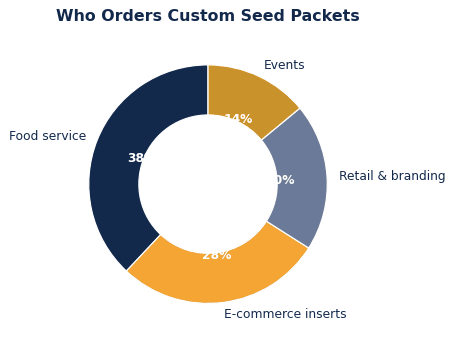
    The common ways brands put custom seed packets to work.
    The common ways brands put custom seed packets to work.

    Most orders lean toward one primary job with a secondary benefit — a shipping-focused seed packets that also brands the unboxing, or a gift-focused one that also protects. Naming your primary use keeps the order focused and the spec appropriate.

    Use case What it needs
    Food service branded, food-safe paper that dresses up a serve
    E-commerce inserts thank-you and instruction cards that build loyalty
    Retail & branding labels and wraps that reinforce the brand
    Events printed pieces that tie a theme together

    Matching material and size to the use

    Once the use is clear, the material and size follow. A protection-first job favors a durable, well-fitted build; a presentation-first job favors a premium material and a clean print; a promotion-first job favors a cost-effective option you can order in volume. Sizing to the product with a small margin keeps the seed packets looking intentional and performing its job.

    If a single order serves more than one use, spec to the most demanding one so the seed packets performs everywhere. It is easier to use a slightly sturdier or more premium seed packets across the board than to discover a bargain option falls short for your most important use case.

    Branding for the impression you want

    Decoration should reinforce the impression the use calls for. Digital and offset printing reproduce full-color art crisply, with spot colors and foil available for a premium touch. For a premium or gift use, lean on finishes and restraint; for high-volume promotion, prioritize a bold, legible logo that reads at a glance and reproduces affordably at scale. Keep branding consistent with the rest of your packaging or merch so everything reads as one system.

    The most-requested options below reflect what buyers reach for most, and they are a useful starting menu when you brief your order. Whatever you choose, approve a proof so the finished custom seed packets match the impression you intended.
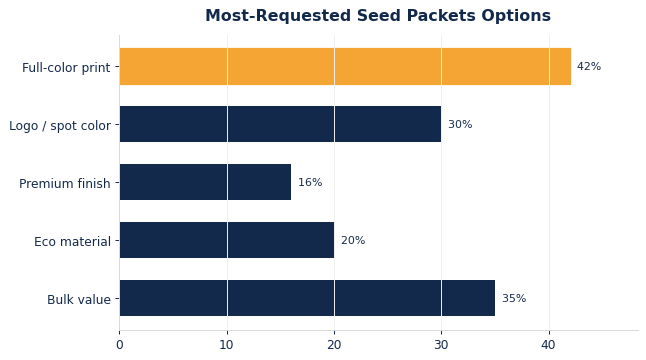
    The options buyers request most on custom seed packets.
    The options buyers request most on custom seed packets.

    Getting the size and details right

    Even with the use and material decided, the details are what make custom seed packets feel finished. Confirm the size and weight against the product with a small margin, check the print area for your chosen size so the logo sits cleanly, and decide on any finishing touches before you brief the order. These small confirmations up front are what separate a seed packets that looks intentional from one that looks close-enough.

    A sample or proof is the cheapest insurance you can buy on a seed packets order. A physical sample lets you judge the material and print in hand, while a digital proof confirms artwork, color, and size and weight before the full run. Spending a few minutes here prevents the far larger cost of reworking a finished order of custom seed packets that missed on a detail.

    Ordering: quantities, lead time, and reorders

    A smooth seed packets order comes down to a few basics: order for real demand plus a small overage, send print-ready artwork early, and confirm lead time against any deadline so production and shipping fit your timeline. Per-unit cost drops with volume, so consolidating a season’s needs into one run is usually more efficient than repeated small orders.

    Keep your approved artwork and spec on file so reorders are a quick repeat rather than a fresh setup each time — consistency across runs keeps your brand looking deliberate.

    Coordinating with the rest of your brand

    Custom seed packets rarely stand alone; they sit alongside your other packaging, print, or merch, so coordinating them strengthens the whole brand. Carrying the same logo, colors, and tone across your seed packets and your other pieces makes everything read as one deliberate system rather than a set of one-off orders. That consistency is what makes a brand feel established, and it costs nothing extra to plan.

    Coordination also simplifies buying over time. Standardizing on a material, size, and decoration you are happy with turns future orders into simple repeats, and it keeps every batch matching the last. A little upfront alignment pays back every time you reorder custom seed packets.

    Frequently asked questions about custom seed packets

    What are custom seed packets used for?

    Custom seed packets serve a mix of protection, presentation, and promotion across food service, e-commerce inserts, retail & branding, and events. Most orders lean toward one primary job with a secondary benefit, so naming your main use is the first step in speccing the right seed packets.

    How do I match custom seed packets to my use?

    Let the use drive the spec: durable and well-fitted for protection, premium and clean for presentation, cost-effective and bold for promotion. If one order serves several uses, spec to the most demanding one so the seed packets performs everywhere.

    How should I brand custom seed packets?

    Digital and offset printing reproduce full-color art crisply, with spot colors and foil available for a premium touch. Choose finishes and restraint for premium or gift uses, and a bold, legible logo for high-volume promotion, keeping the branding consistent with your other packaging or merch so it all reads as one system.

    How far ahead should I order custom seed packets?

    Order for real demand plus a small overage, send print-ready artwork early, and confirm lead time against any deadline so production and shipping fit your timeline. Consolidating a season’s needs into one run is usually more efficient than repeated small orders.

    Can I reorder easily?

    Yes. Keeping your approved artwork and spec on file makes reorders a quick repeat rather than a fresh setup, and it keeps every batch of custom seed packets matching the last for a consistent brand look.

    Do I need a sample before ordering custom seed packets?

    A sample is worth it for a first order or a new material, since judging feel and print in hand removes the guesswork. For a straightforward reorder of custom seed packets you have bought before, a digital proof confirming artwork and size and weight is usually enough.

    Match the seed packets to the job, spec it deliberately, and approve a proof, and your order will do exactly what you needed. For the full material and sizing breakdown, see our companion guide, our Custom Seed Packets: Materials, Sizing & Branding Guide, and browse our our shop to get started.

    Not sure which custom seed packets fit your use?

    Tell us how you’ll use them and we’ll match the material, size, and branding to the job.
    Get a Quote

  • Custom Seed Packets: Materials, Sizing & Branding Guide

    Custom Seed Packets: Materials, Sizing & Branding Guide

    Custom Seed Packets: A Materials, Sizing, and Branding Guide

    Getting custom seed packets right comes down to three decisions: the material, the size or spec, and how you brand them. Make those well and you end up with custom seed packets that protect and present your product, reinforce your brand, and land on budget. This guide walks through the material options, how to size and spec your order, and how to decorate custom seed packets so they do real work for your brand rather than just checking a box.

    Whether you are ordering your first run or reordering at scale, the same fundamentals apply. Choosing custom seed packets deliberately — material to job, size to product, decoration to brand — is what separates an order you are proud of from one you settle for.

    Why custom seed packets matter for your brand

    Custom seed packets are more than a commodity; they are a touchpoint brands experience directly. A well-chosen, well-branded option signals quality and attention to detail, while a generic one quietly undercuts an otherwise strong product. Because custom seed packets are seen and handled, they carry your brand into the world every time they are used.

    That visibility is exactly why it pays to spec custom seed packets intentionally. The material sets the feel, the size sets the fit and cost, and the decoration sets the impression — and getting all three aligned turns a functional item into a genuine brand asset.

    Materials and options compared

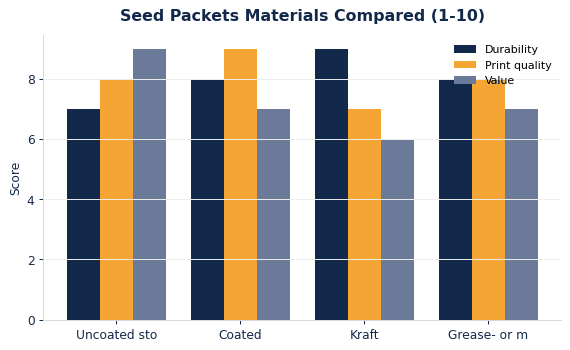
    The common materials for custom seed packets each trade off durability, print quality, and cost: uncoated stock, coated / gloss stock, kraft / recycled, and grease- or moisture-resistant. The right pick depends on how the seed packets will be used, the look you want, and your budget. The chart and table below compare the main options so you can match material to job.

    How common seed packets materials compare on durability, print quality, and value.
    How common seed packets materials compare on durability, print quality, and value.

    As a rule of thumb, choose a recyclable or natural material when eco positioning matters, a coated or laminated option when you want vivid full-color print, and a premium build when the seed packets is part of a gift or high-end presentation. When in doubt, request a sample so you can judge feel and print before committing to a full run.

    Material / option Best for
    Uncoated stock natural, writable surface with a matte look
    Coated / gloss stock vivid color and a polished finish
    Kraft / recycled eco-forward, warm natural tone
    Grease- or moisture-resistant food-safe performance where needed

    Sizing and specs

    Sizing is where many seed packets orders go wrong, so measure before you order. Custom seed packets typically range from a small insert card up to a full wrap or liner sheet, and the right size and weight depends on the product or use they serve. Too small and the fit is tight or the product is exposed; too large and you pay for material you do not need and lose a clean, intentional look.

    When a measurement falls between standard options, size to the product with a small margin rather than guessing. Confirming the size and weight on a proof or sample before a large run prevents the costly mistake of a full order that does not fit, which is far more expensive to fix than a five-minute check up front.

    Branding and decoration

    Decoration is what turns a plain seed packets into a branded one. Digital and offset printing reproduce full-color art crisply, with spot colors and foil available for a premium touch. Match the method to your artwork and budget: simple logos reproduce cleanly and cheaply, while detailed, full-color designs shine with the right process on the right material. Keep the artwork vector where possible and confirm the print area for your chosen size.

    Restraint usually reads as premium. A clean logo, one or two brand colors, and quality material almost always look more considered than a busy, over-printed design. Approving a proof before the run protects both the look and the budget, especially on a large order of custom seed packets.

    Ordering and budget

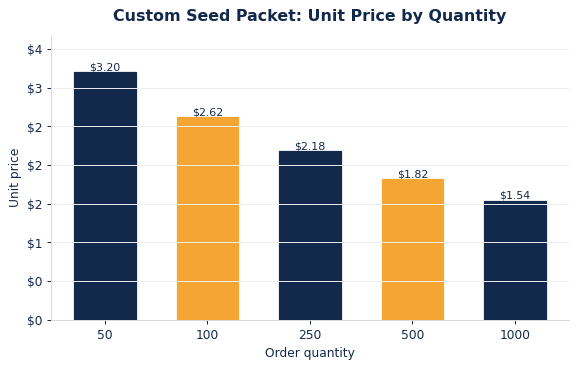
    Per-unit cost on custom seed packets falls steadily with volume as setup amortizes across more pieces, so ordering for real demand rather than a token first batch is usually the efficient move. The curve below shows how pricing typically improves with quantity, which helps you plan an order that balances cash and cost.

    Typical per-unit seed packets pricing as order quantity increases.
    Typical per-unit seed packets pricing as order quantity increases.
    Ordering for a recurring need? A single larger run lowers the unit cost and keeps your branding consistent, while a small overage covers reorders and the occasional damaged piece without a rush order.

    Common mistakes to avoid

    A few avoidable missteps account for most disappointing seed packets orders. Ordering before measuring is the biggest, followed by choosing a material for price alone without considering how the seed packets will actually be used, and skipping the proof on a large run. Each is easy to prevent with a few minutes of planning, and each is expensive to fix once a full order is produced.

    The other common trap is over-designing the artwork. Cramming in too many colors, effects, or details can muddy the print and raise the cost, especially on textured or recycled materials. Simplifying the design to a clean, legible mark almost always improves both the look and the price of your custom seed packets.

    Frequently asked questions about custom seed packets

    What material is best for custom seed packets?

    It depends on the use: choose a recyclable or natural material for eco positioning, a coated or laminated option for vivid full-color print, and a premium build for gifting or high-end presentation. Request a sample to judge feel and print before a full run of custom seed packets.

    How do I choose the right size?

    Measure the product or use the seed packets serves, then size to it with a small margin so the fit is clean without wasting material. When a measurement falls between standard options, size up slightly and confirm the size and weight on a proof before ordering in volume.

    How are custom seed packets branded?

    Digital and offset printing reproduce full-color art crisply, with spot colors and foil available for a premium touch. Match the method to your artwork and budget, keep the art vector where possible, confirm the print area for your size, and approve a proof so the finished custom seed packets match your intent.

    How does pricing work, and is there a minimum?

    Per-unit cost drops with quantity as setup amortizes across the run, so larger orders are more cost-effective. Order for real demand plus a small overage rather than a token batch, and consolidate recurring needs into one run for the best price.

    Can I get a sample or proof before ordering?

    Yes, and it is strongly recommended. A physical sample lets you judge material and print, and a digital or physical proof confirms your artwork, color, and size and weight before a full run — a small step that prevents a costly mistake on a large order.

    What do you need to quote custom seed packets?

    To quote accurately we need the size and weight or the product they serve, the quantity, your material preference, and your artwork or a description of the branding. With those details we can recommend the right material and size and give you pricing for the run, and a proof follows once the order is confirmed.

    Whatever you order, send vector artwork, confirm material and size and weight, and approve a proof before production. For help matching custom seed packets to a specific use, see our companion guide, our How to Choose Custom Seed Packets for Your Brand, and explore our our shop to start your order.

    Ready to order custom seed packets?

    Tell us your product, quantity, and branding and we’ll match the material, size, and decoration for you.

    Get a Quote

  • A Nonprofit’s Guide to Seed Packet Fundraising Margins — Customized Seed Packets

    Call or Text us: (929) 605-4397

    HomeBlog › A Nonprofit's Guide to Seed Packet Fundraising Margins

    Fundraising

    A Nonprofit’s Guide to Seed Packet Fundraising Margins

    06/30/2026

    Seed packets have become a quiet staple of nonprofit fundraising — low cost per unit, a natural tie to environmental and community missions, and a giveaway that keeps the organization’s name in front of a donor for months after a single event or mailer. Getting the margin math right up front makes the difference between a fundraiser that pays for itself and one that just breaks even.

    Understand your landed cost

    Landed cost is everything it takes to get a finished packet into a supporter’s hands: the packet and printing, the seed fill, and shipping to your distribution point. At typical nonprofit order volumes, per-unit cost for a Wildflower Mix Packet or Standard Seed Packet generally falls within our published range, with the lower end of that range reached at higher quantities.

    Choose a pricing or ask model that fits your channel

    Most nonprofits use one of three models: a suggested-donation giveaway at events (free with a suggested amount), a direct add-on sale during a membership or appeal mailer (a fixed price per packet or bundle), or a bundled incentive gift for donors above a certain giving level. Each model has a different implied margin, so decide which one fits your channel before you set your order quantity.

    ModelTypical structureMargin consideration
    Event giveawayFree, suggested donationCost absorbed into event budget; measure by engagement, not direct margin
    Appeal add-on$3–$5 per packet or small bundleStrong margin above landed cost; scales with mailer size
    Donor incentiveFree gift above a giving thresholdCost treated as a cost of donor acquisition, not a direct sale

    Order in the right volume tier

    Because per-unit price improves meaningfully as order size grows, it’s usually more efficient to consolidate a year’s programs — a spring appeal, a fall gala, and a membership renewal — into one larger order than to place three smaller ones. Our minimum is 250 units, and most established nonprofit programs order in the low thousands once they’ve proven the format works with their donor base.

    Reuse artwork across campaigns

    We keep your artwork and seed specs on file, so a reorder for the next campaign moves faster and doesn’t require a new design cycle unless your messaging changes. Many organizations run the same core design for a full fiscal year, adjusting only a date or a campaign name.

    Key takeawayPick a pricing model that matches your channel, consolidate your annual programs into fewer, larger orders, and reuse artwork across campaigns to keep landed cost low.

    Ready to plan your next campaign? Get a custom quote — free mockups in 24 hours. Learn more about how we work, or browse more guides.

    More posts

  • How to Order Custom Seed Packets: A Step-by-Step Checklist — Customized Seed Packets

    Call or Text us: (929) 605-4397

    HomeBlog › How to Order Custom Seed Packets: A Step-by-Step Checklist

    Ordering

    How to Order Custom Seed Packets: A Step-by-Step Checklist

    06/07/2026

    Ordering custom seed packets for the first time involves fewer decisions than most people expect, but getting them in the right order saves a round of back-and-forth. Here’s the checklist we walk every new customer through.

    1. Pick your seed variety

    Start with what the packet needs to hold: a single-variety flower, a wildflower or pollinator blend, an herb, or a curated retail line across several SKUs. Your use case usually points to an obvious answer — wildflower for sustainability and nonprofit programs, herbs for kitchen-garden gifting, a specific bloom for weddings that need to match a color palette.

    2. Choose a packet style

    Match the format to where the packet will live: a Standard Seed Packet for general giveaways, a Wedding Favor Seed Packet for place settings, a Retail Shelf Seed Packet if it needs a hang-hole and barcode for a store rack. If you’re not sure, tell us the end use and we’ll recommend one.

    3. Gather your artwork

    Vector files (AI, EPS, SVG, or PDF) are ideal. If you only have a logo as a photo or low-res PNG, send it anyway — our designers rebuild artwork print-ready at no charge. Have your brand colors or Pantone numbers on hand if exact color matching matters.

    4. Confirm your quantity and deadline

    Our minimum is 250 units. Round up to your event or launch date with a buffer for the mockup-and-approval cycle — standard production runs about two weeks from approved artwork, so submit your request at least three weeks before you need product in hand, longer for large or multi-SKU orders.

    5. Submit your quote request

    Fill out the quote form with your use case, quantity, seed and color preferences, and any deadline. We reply within one business day with a photo-real mockup and bulk pricing.

    6. Review and revise

    Revisions are unlimited and free until you approve. Check names, dates, and seed variety spelling carefully at this stage — this is the step that exists specifically so nothing needs correcting after production starts.

    7. Approve, pay, and production begins

    Once you sign off, we lock the design and start production the same day. You’ll receive tracking once your order ships.

    StepTypical timing
    Quote requestSame day submission
    First mockupWithin 24 hours
    RevisionsAs many rounds as needed, free
    Production after approvalAbout 2 weeks
    Key takeawayPick your seed variety and packet style, gather your artwork, and submit your quote at least three weeks before your in-hands date.

    Ready to start? Get a custom quote — free mockups in 24 hours. Learn more about how we work, or browse more guides.

    More posts

  • Do Cheap Seed Packets Actually Hurt Germination Rates? — Customized Seed Packets

    Call or Text us: (929) 605-4397

    HomeBlog › Do Cheap Seed Packets Actually Hurt Germination Rates?

    Buyer guides

    Do Cheap Seed Packets Actually Hurt Germination Rates?

    05/17/2026

    Short answer: yes, indirectly — but not because of the paper itself. The seed inside a packet is only as good as the environment it’s stored in before planting, and a poorly made packet fails at exactly the job it exists to do: keeping moisture, light, and air away from the seed until someone opens it.

    Here’s what actually affects viability, and where a cut-rate packet quietly works against you.

    Sealed vs. glued vs. folded

    A heat-sealed packet creates a continuous bond along every edge, which meaningfully slows moisture and air exchange compared to a glued seam or a simple folded-and-stapled closure. Cheaper packets often use spot glue or a fold-over flap that looks fine on a shelf but leaves small gaps where humidity gets in over weeks or months of storage — exactly the timeframe a retail seed packet or a corporate gifting program sits before it’s finally planted.

    Paper weight and light exposure

    Thin, uncoated stock lets more ambient light and moisture through the packet wall than a heavier coated paper. Most seed varieties tolerate brief light exposure without issue, but extended storage in a sunny display window or a warm car can measurably reduce viability in lower-grade packaging faster than in a properly sealed, coated packet.

    Storage matters more than most people think

    Storage conditionEffect on viability
    Cool, dry, dark storageBest case — most varieties hold well for a full season or more
    Room temperature, indirect lightGradual decline over many months; still generally fine within a season
    Direct sun or high heat (car, warehouse window)Accelerated decline; can meaningfully cut germination within weeks
    High humidity, poor sealFastest decline; risk of mold or premature sprouting inside the packet

    What this means for your order

    If your seed packets will sit on a shelf, in a mailer, or in a gift box for more than a few weeks before planting — which describes almost every retail, nonprofit, and corporate gifting program — the packet construction is doing real work, not just cosmetic work. That’s why we build every packet on heat-sealed, coated stock as the baseline rather than an upgrade option.

    Key takeawayA heat-sealed, coated-stock packet protects germination rates meaningfully better than a glued or folded cheap packet, especially for orders that sit for weeks before planting.

    Want packaging that protects what’s inside it? Get a custom quote — free mockups in 24 hours. Learn more about how we work, or browse more guides.

    More posts

  • Custom Seed Packets for Garden Centers & Nurseries — Customized Seed Packets

    Call or Text us: (929) 605-4397

    HomeBlog › Custom Seed Packets for Garden Centers & Nurseries

    Garden Centers

    Custom Seed Packets for Garden Centers & Nurseries

    04/26/2026

    Most garden centers sell seed packets from a handful of national brands on a spinner rack, and most customers can’t tell one rack from another. A private-label seed packet line changes that — it turns a commodity aisle into a signature product that only your store carries, and it usually carries a healthier margin than reselling a national brand.

    Here’s how the garden centers and nurseries we work with typically structure a private-label program.

    Start with a signature lineup, not a full catalog

    You don’t need fifty varieties to make an impact. Most stores start with 5–8 SKUs — a regional wildflower mix, two or three popular herbs, and a couple of vegetable varieties that match what your customers already ask about most. A focused lineup keeps your first order manageable and gives you real sales data before you expand.

    Design for the shelf, not just the brand

    Our Retail Shelf Seed Packet format is built with this in mind — a reinforced hang-hole for pegboard display, a heavier stock that holds up under repeated handling, and a dedicated barcode block on the back panel. Front-panel design should read clearly from a few feet away: variety name, a clean illustration or photo, and your store’s branding, with growing details reserved for the back where a customer reads once they’ve already picked it up.

    Price for margin, not parity

    Because you’re not paying a wholesale markup to a national brand, a private-label packet typically supports a better margin at the same retail price point — or the same margin at a lower price that undercuts the rack next to it. Many stores price their private-label line at or slightly below national brands specifically to drive trial, then rely on repeat purchase and loyalty to your name for the following season.

    Program stageTypical approach
    Launch5–8 signature SKUs, 250–500 units each
    Season 2Reorder proven sellers, add 2–3 new varieties
    EstablishedFull private-label rack replacing national brands in key categories
    Key takeawayLaunch a focused 5–8 SKU private-label line, design for shelf visibility with a barcode-ready back panel, and let repeat sales guide your next season’s expansion.

    Ready to build your store’s seed packet line? Get a custom quote — free mockups in 24 hours. Learn more about how we work, or browse more guides.

    More posts

  • Kraft vs. Full-Color Print: Choosing a Finish for Your Seed Packets — Customized Seed Packets

    Call or Text us: (929) 605-4397

    HomeBlog › Kraft vs. Full-Color Print: Choosing a Finish for Your Seed Packets

    Buyer guides

    Kraft vs. Full-Color Print: Choosing a Finish for Your Seed Packets

    04/05/2026

    Of the color options we offer, two account for most of our orders: Kraft with a single-color print, and Full-Color Print across the entire front panel. They serve very different brand instincts, and the right choice usually becomes obvious once you compare them side by side.

    Neither finish is objectively better — the right one depends on your brand’s visual language and what shelf or table the packet needs to compete on.

    Kraft: understated and artisan

    Kraft stock, printed in one or two colors, reads as natural, handmade, and unfussy. It is the finish of choice for brands leaning into a rustic, farm-table, or minimalist aesthetic — wedding favors for a barn venue, herb packets for a farm-to-table restaurant, or nonprofit giveaways where a lower-cost print run stretches a fundraising budget further. Kraft also photographs well against natural light and wood surfaces, which matters if your packets are going to end up on social media.

    Full-Color Print: bold and brand-forward

    Full-Color Print covers the entire front panel edge to edge, reproducing logos, gradients, and photography accurately. It is the right call when brand recognition matters more than texture — a corporate sustainability program that needs to match an existing brand guide exactly, a retail shelf product competing against colorful national seed brands, or a wedding with a detailed, illustrated invitation suite the couple wants mirrored on the favor.

    FactorKraftFull-Color Print
    LookNatural, artisan, understatedBold, brand-accurate, vivid
    Cost per unitLowerSlightly higher
    Best forRustic weddings, nonprofits, farm brandsCorporate, retail shelf, detailed illustration
    Brand color accuracyLimited to 1–2 spot colorsFull Pantone-matched color range

    Choosing for your order

    If your existing brand materials are colorful and detailed, Full-Color Print will look most consistent with everything else you produce. If your brand leans handmade, sustainable, or minimal — or your budget favors a lower per-unit cost at very high volume — Kraft is usually the better fit. Many brands also test both: a Kraft version for a nonprofit mailer and a Full-Color version for a retail shelf launch of the same seed variety.

    Key takeawayChoose Kraft for a natural, cost-efficient look; choose Full-Color Print when exact brand color matching and shelf standout matter most.

    Not sure which finish fits your brand? Get a custom quote and we’ll recommend one with your free mockup. Learn more about how we work, or browse more guides.

    More posts

  • Custom Seed Packets for Wedding Favors: Quantity & Personalization — Customized Seed Packets

    Call or Text us: (929) 605-4397

    HomeBlog › Custom Seed Packets for Wedding Favors: Quantity & Personalization

    Weddings

    Custom Seed Packets for Wedding Favors: Quantity & Personalization

    03/15/2026

    Seed packet favors have become one of the most requested wedding favors we produce, and for good reason — they are inexpensive at scale, they photograph beautifully on a place setting, and unlike a candle or a shot glass, they don’t end up in a junk drawer. But getting the quantity and personalization right takes a little more planning than picking a design and hitting order.

    This guide covers the two questions we hear most from couples and planners: how many should I order, and what should I actually put on the packet.

    Quantity: count guests, not invitations

    The most common ordering mistake is counting invitations instead of guests. A couple inviting 150 households might actually be hosting 220 guests once plus-ones and families are counted — and favors are typically placed per seat, not per household. Start from your final seating chart, add 10–15% for last-minute additions, breakage, and keepsakes for the wedding party, and round up to the next comfortable order tier.

    Guest countSuggested orderNotes
    Up to 100250 (minimum)Covers guests plus a buffer for the wedding party and keepsakes
    100–200300–400Order in round numbers; price breaks often land near 300+
    200–350450–600Confirm your final count before locking production
    350+700+Ask about volume pricing tiers past 500 units

    Personalization: what actually goes on the packet

    Most couples personalize the front panel with their names and the wedding date, then use a short line — “thank you for celebrating with us” or “let love grow” — as a secondary line. We handle this through variable data printing, which means every packet in the run can carry the same design without a manual re-run if your guest count shifts slightly before the final order.

    The seed variety matters more than couples expect. Wildflower mixes suit outdoor and garden weddings; a single statement bloom that matches your florals reads more formal; herbs fit a rustic or farm-table reception especially well when paired with a small recipe card. If you’re unsure, tell us your venue and season and we’ll recommend a mix.

    Timing: when to order

    Order your favors once your final guest count is close to locked — typically 6–8 weeks before the wedding. This gives enough time for a design mockup, one or two rounds of revisions, and standard production, without ordering so early that a late guest-count change forces a costly reprint.

    Key takeawayCount guests, not invitations, add a 10–15% buffer, and order once your final headcount is close to locked — about 6–8 weeks out.

    Ready to plan your wedding favors? Get a custom quote — free mockups in 24 hours. Learn more about how we work, or browse more guides.

    More posts