A custom seed packet is judged twice: once when someone admires the printing, and again months later when they push the seeds into soil and wait. The second test is the one that matters, and it is decided less by the packet’s looks than by which seeds went inside, how old they were, and where the box sat between your order and the recipient’s garden. If you are printing favors for a spring wedding, promotional packets for a trade show, or a fundraising run that will sell down slowly, it pays to understand what actually keeps seeds alive so the germination photo you are picturing is the one people get.
Viability is a species trait first
Before storage or packaging enters the picture, the species sets the ceiling. Seeds are living tissue, and different plants simply hold their spark for different lengths of time. At the short end, onion, leek, spinach, and parsnip seed is notoriously fleeting, often reliable for only one to two years even under good conditions. In the middle sit carrots at roughly three to four years and beans around three. At the durable end, tomato, lettuce, cucumber, brassicas, and radish commonly stay viable for four to six years, and a few flowers such as calendula are cited well beyond that. These are ranges, not guarantees; they describe seed kept cool and dry, and they slide downward as conditions worsen.
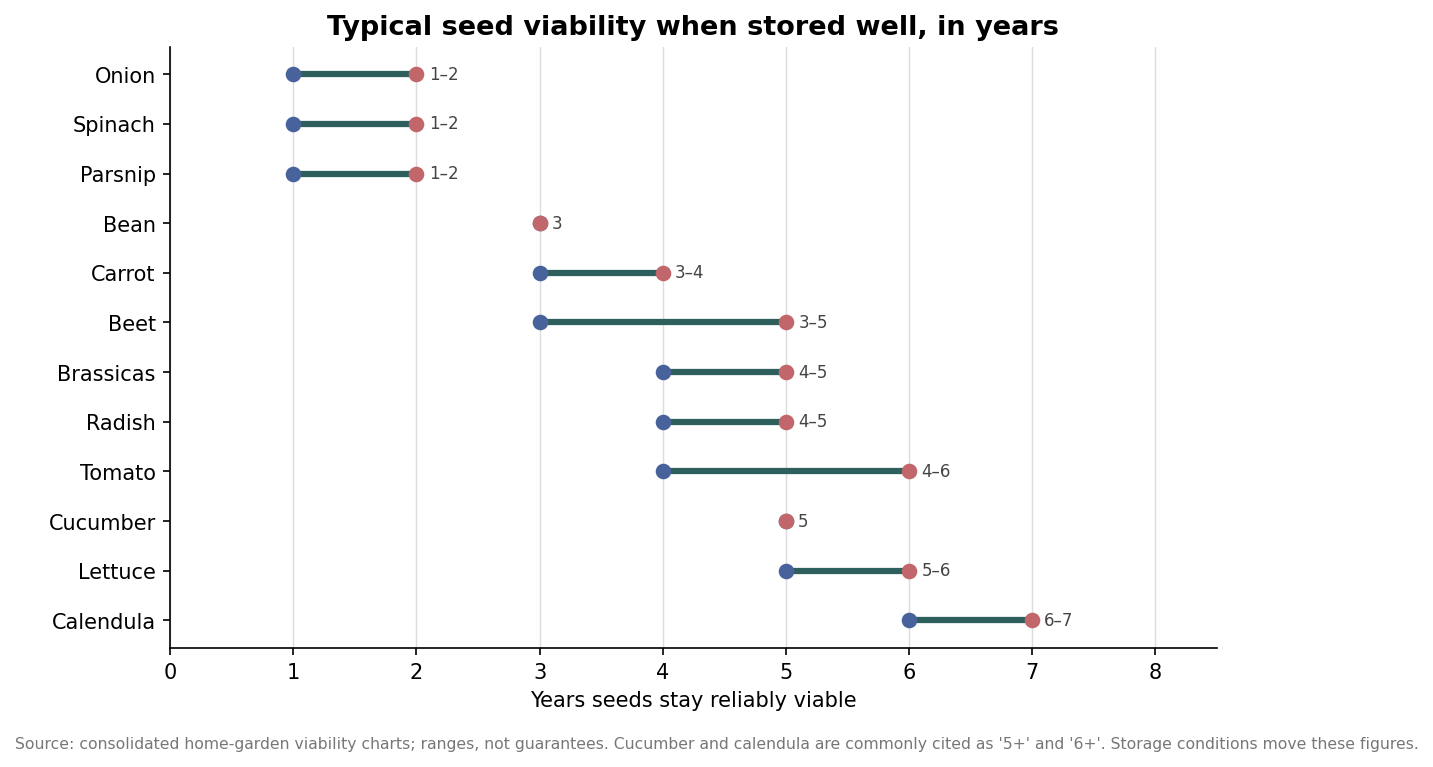
The practical takeaway for a custom order is to match the species to how long the packet will realistically sit before planting. A wildflower or tomato mix tolerates a slow sell-through; an allium or spinach packet distributed a year after you bought the seed is already fighting its own biology. If a campaign will run for many months, lean toward the long-lived species, or plan to refresh the seed stock rather than the print run.
The rule that governs the rest: temperature plus humidity
Seed people carry one rule of thumb that captures most of what goes wrong in storage: the temperature in degrees Fahrenheit plus the relative humidity as a percentage should stay under 100, and the further below that total you get, the longer seeds last. A cool, dry closet at about 40°F and 40% humidity totals 80 and is comfortably favorable. A warm room shelf at 70°F and 50% humidity totals 120 and quietly ages seed faster than most people realize. Heat speeds the seed’s respiration, and moisture invites the mold and insects that finish the job.
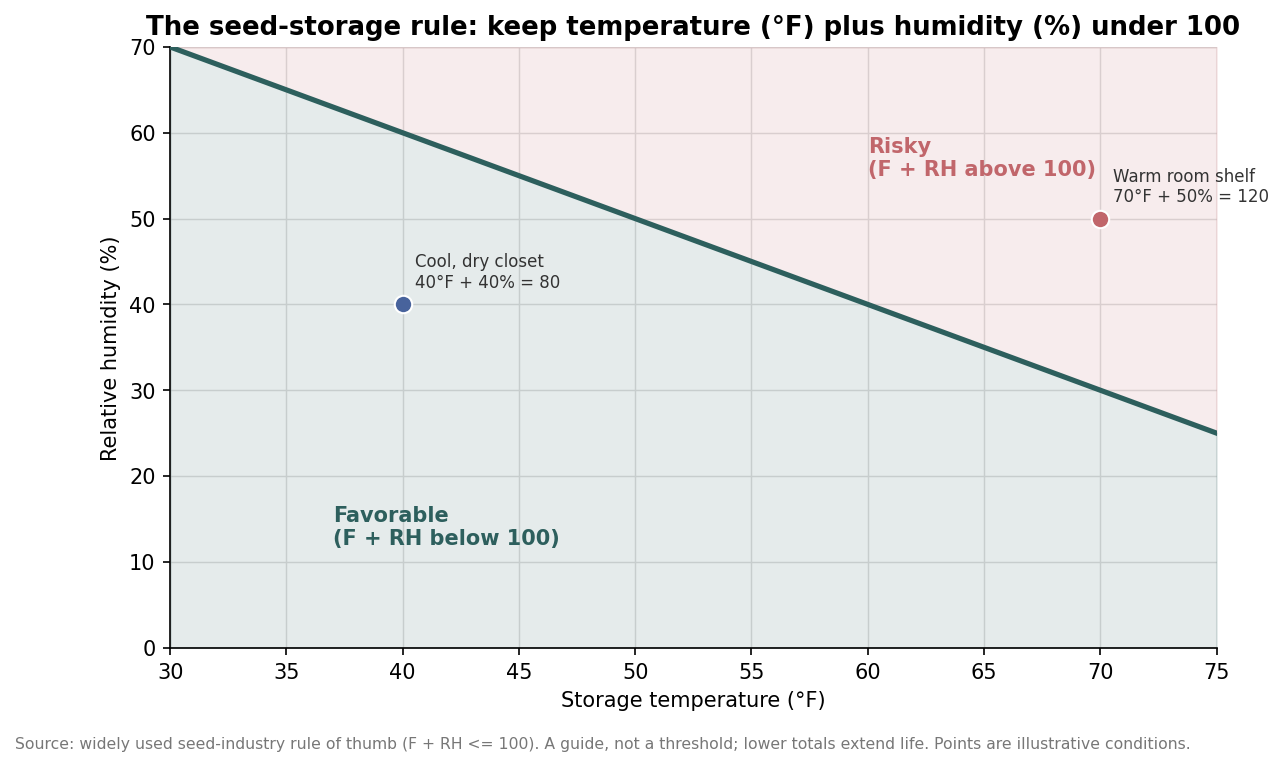
Commercial seed is dried to under about 10% moisture after harvest precisely so it ships in a stable state, and short-term storage guidance typically points at 35 to 50°F with 30 to 40% relative humidity. You cannot control the recipient’s shelf, but you can control the months the packets spend in your possession. A garage that bakes in summer or a basement that sweats in humidity is exactly the wrong holding spot; a climate-steady interior closet is the right one. Pelleted or coated seed is a special case worth flagging, since the coating shortens shelf life and is generally best used within a single year.
What the packet itself can and cannot do
Packaging is the last line of defense, and it is important to be honest about its limits. A standard paper seed packet breathes, which is perfectly fine for seed that will be handed out and planted within a season, and it is the traditional look most buyers want for weddings and events. What paper does not do is create a moisture barrier, so it will not protect seed through a humid summer in storage. When packets need to hold for many months, a foil-lined or poly-laminate envelope seals out moisture far better, and a tiny silica desiccant tucked into bulk storage keeps the surrounding air dry. The choice is a genuine trade-off between the paper look and the barrier performance, and the right answer depends entirely on your timeline.
Print finish plays a quiet supporting role here too. A coated or laminated exterior resists the handling and humidity of a market table better than an uncoated kraft face, though neither finish changes what happens to seed sealed inside a breathable paper pocket. If longevity is the priority, solve it with the inner barrier and storage conditions rather than expecting the outer print to do that work.
Ordering ahead without gambling on germination
The tension in most custom seed-packet orders is that printing rewards planning ahead while seed viability punishes it. You resolve it by separating the two clocks. Lock in artwork, proofs, and quantities early, because those never expire, and time the actual seed fill as close to distribution as the production schedule allows. If you must buy seed well in advance, buy long-lived species, store them cool and dry per the rule above, and note the seed’s own packed-on or test date so you know how much runway is left. For anything mission-critical, ask your supplier for the germination rate the seed lot was tested at; reputable seed carries a tested percentage, and a lot in the 85 to 95% range gives you real margin.
Testing a batch before it goes out
You do not have to trust the numbers blindly. A simple rag-doll germination test settles it: count out ten seeds, roll them in a damp paper towel, keep it warm, and check after the species’ expected germination window of roughly a week to two. Seven or more sprouts out of ten points to a healthy lot; three or four is a warning to refresh the stock before you commit it to hundreds of packets someone is counting on. Running that test on a pinch of seed costs almost nothing and turns viability from a hope into a measured fact, which is exactly the confidence you want before a run goes out under your name.
Leave a Reply